
Calendars & Intel deep dive · 16 min read
How to Use the Dividend Calendar
A complete walkthrough of the Dividend Calendar at /dividends. Card anatomy, early-assignment risk explained in plain English, and three concrete workflows for covered-call and wheel traders using the 60-day ex-date view.
Open the tool →Hey guys, Art from TraderMatrix here. The Dividend Calendar at /dividends is one of those pages that looks simple until the moment you need it, and then it looks very simple in exactly the wrong direction. Covered-call and wheel sellers open it expecting a dry table of dates. What they actually need is to understand what those dates mean for an open short call position, because the platform's subtitle says it plainly: in-the-money short calls carry elevated early-assignment risk the day before ex-dividend.
This guide walks through the whole page: what each card field means, how early assignment actually works (not the abstract version, the mechanical one), and three workflows I use regularly. The examples come from the real calendar as of October 19, 2026.
The short version:
- The calendar shows ex-dividend dates, not pay dates. Early-assignment risk is tied to the ex-date.
- An option buyer can exercise your short call early to capture the dividend. This becomes rational when the dividend exceeds the remaining time value in the call.
- Deep out-of-the-money calls are rarely assigned early. In-the-money calls in the week before ex-date are the exposure.
- Free members see the nearest upcoming dates. Premium shows the full 60-day forward calendar.
- Each card links to the Long Term page for that name, where you can check dividend safety and the full fundamental picture.
What this page is and what it isn't
The Dividend Calendar is not a screening tool for finding high-yield stocks to buy. There are better resources for that. It's a risk-management calendar for people who sell options on dividend-paying names.
Covered-call sellers and wheel traders face a specific mechanical risk that most options education skips over: early assignment. The calendar exists so you can check whether any name in your portfolio has an ex-dividend date approaching before you roll, close, or add a new position.
The data is sourced from Yahoo Finance and covers the optionable universe. Dates and rates are subject to company confirmation. Special or irregular dividends may not appear until close to the announcement date.
Free members see a server-side slice of the nearest upcoming ex-dates and an upgrade prompt for the rest. Premium unlocks the full 60-day forward calendar, which can run up to 300 rows across dozens of ex-dates.
How early assignment actually works
Before the tour, the mechanism. This is the reason the page exists.
When you sell a covered call, you're giving someone the right to buy 100 shares from you at the strike price before expiration. Most of the time, option buyers don't exercise early. Waiting until expiration captures any remaining time value in the contract, and exercising early throws that away. So early exercise is usually irrational.
Dividends change the math.
To receive a quarterly dividend, you need to own shares at market close on the day before the ex-dividend date. That's the eligibility cutoff. The actual cash doesn't arrive until the pay date, which is typically two to four weeks later. But whether you receive the dividend at all is decided at close the night before ex-date.
Here's where it hits you as a call seller. Someone holding your short call can exercise it early, pay you the strike price for 100 shares, become the owner of those shares, and then hold through the record date to collect the dividend. If the dividend amount exceeds the remaining time value in the call, this trade is rational for them. They capture more by exercising early than by waiting for the option's expiration value.
For you, that means assignment at the strike price before you expected it. You deliver your 100 shares, collect no dividend even though you owned the shares going into the week, and keep only the original premium you collected. The assignment arrives on a timeline you didn't choose.
Deep out-of-the-money calls are rarely touched this way. The math only works when the call has meaningful intrinsic value, meaning the stock price is above the strike. A 6% yield on a mid-priced stock can amount to a noticeable quarterly payout per 100 shares. A call sitting well in the money going into ex-date week, on a name with a substantial dividend, is a situation to have a plan for.
One thing that catches people: early assignment can happen even when there's still time value left in the call. If the quarterly dividend exceeds the time value remaining, the option buyer comes out ahead by exercising early. The remaining time value is the cost they're absorbing to capture the dividend. When the dividend is larger, that cost is worth paying.
The page layout
The calendar groups names by ex-dividend date in calendar order, starting from today. Each group has a day header (for example, MON, OCT 19 or FRI, OCT 23) and a row of cards under it.
The top of the page has three buttons on the right side: Watch tutorial opens a walkthrough video; Add to My Desk adds the calendar as a module on your My Desk layout; and a share button generates a shareable snapshot. Below the title and subtitle is a "Back to Long Term" link, which takes you to the Long Term section.
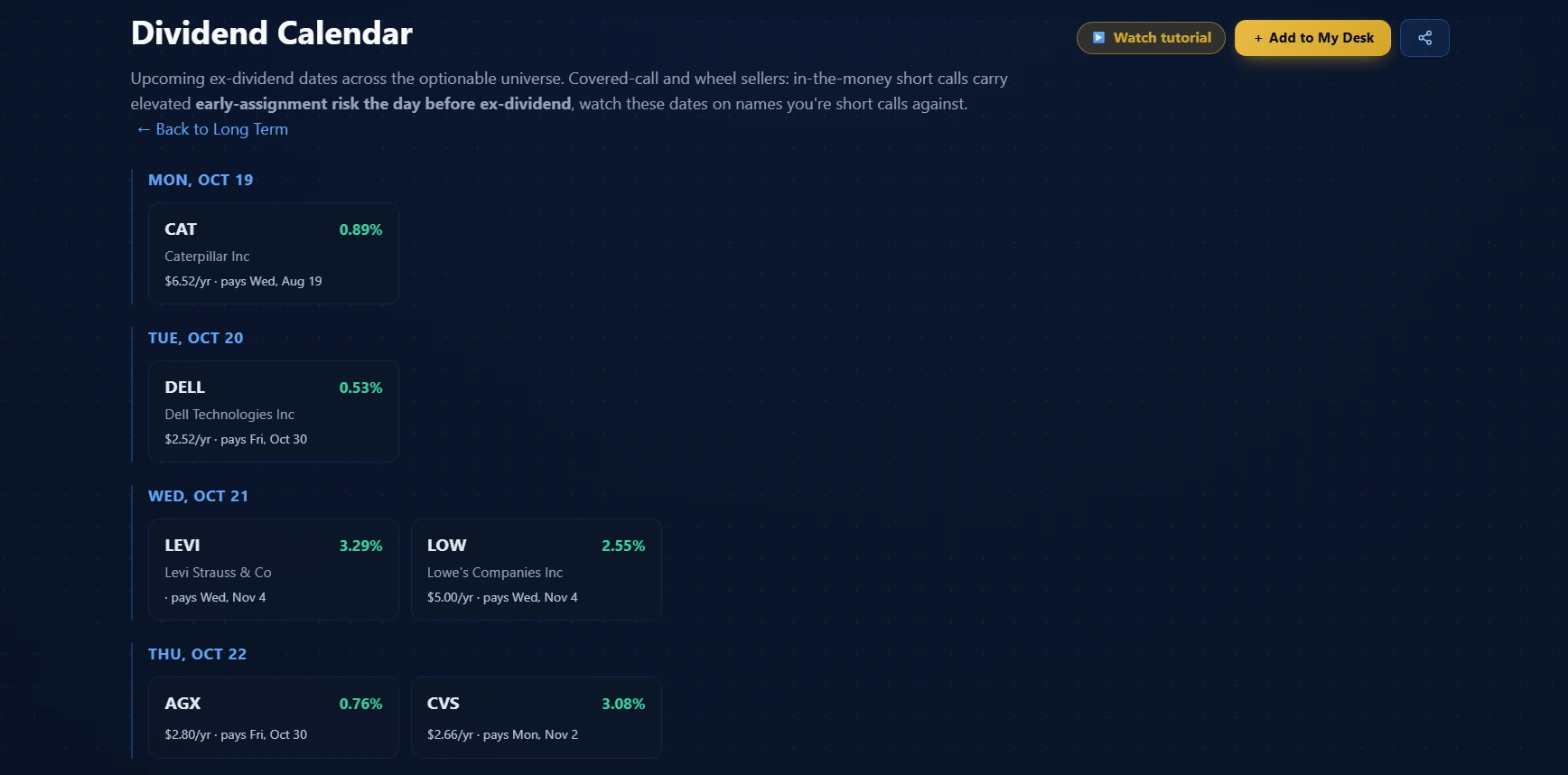 The calendar groups names by ex-date in ascending order. Each date header sits above the cards for that day. This view is from October 19, 2026.
Card anatomy
Each card shows four pieces of information. Here they are in order.
Ticker and yield
The top row of every card shows the ticker symbol on the left and the dividend yield percentage on the right, in green. The yield shown is the trailing annual yield as a percentage of the current stock price. On October 19, the calendar showed CAT at 0.89% yield, LEVI at 3.29%, LOW at 2.55%, CVS at 3.08%.
Yield matters for the early-assignment question. A 0.89% yield like CAT's is a smaller absolute dollar amount per quarter than a 3.29% yield on a similar-priced name. The yield figure is the first number to read when you're assessing assignment risk on a position you hold.
Company name
Below the ticker, the card shows the full company name. This is useful when the calendar is dense and symbols are not immediately recognizable.
Annual dividend rate
Shown as dollars per share per year. LOW shows $5.00/yr, CVS shows $2.66/yr. To get the approximate quarterly payment, divide by four. For LOW that's roughly $1.25 per quarter per share, or $125 per 100-share lot. If you have a short call on LOW sitting $2 in the money going into its ex-date week, and the remaining time value in the call is $0.80, an option holder may choose to exercise early and capture the $1.25 quarterly dividend at the cost of that $0.80 time value. They net $0.45 by exercising early versus waiting.
Pay date
Each card shows the pay date after the annual rate, formatted as "pays [day], [date]." DELL shows "pays Fri, Oct 30." The pay date is when the dividend cash actually clears into accounts. For the early-assignment risk question, the pay date is not the relevant date. It's the ex-date that controls eligibility. The gap between ex-date and pay date can range from less than two weeks to more than a month and doesn't change the assignment dynamics at all.
Clicking any card takes you to the Long Term page for that name, at /long-term, where you can check dividend sustainability scores and the broader fundamental picture.
Deeper into the calendar
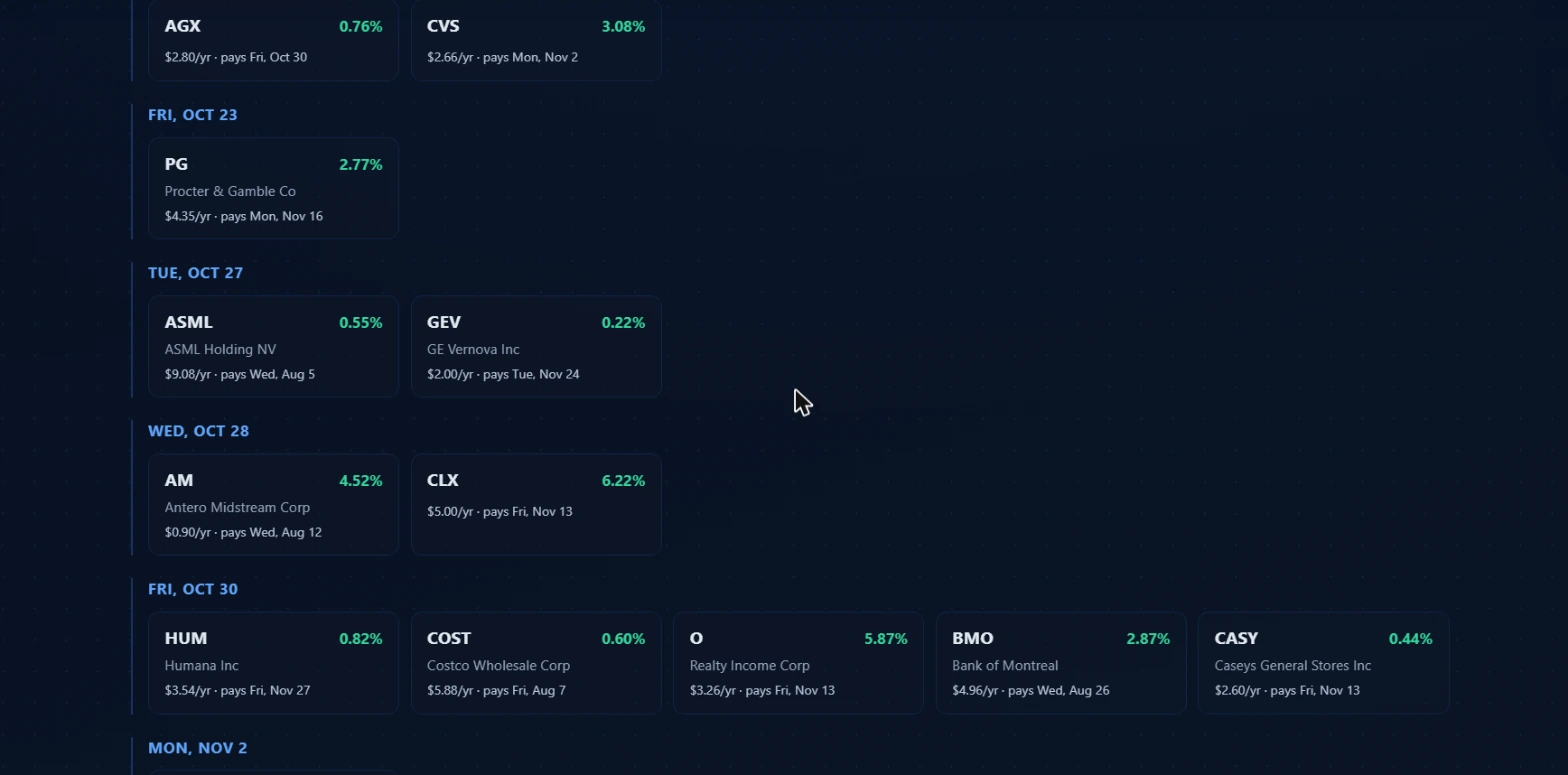 The calendar extends forward up to 60 days. Yield figures vary considerably across the universe, from under 0.5% to over 6%.
Scrolling further into the calendar shows the range of names and yields that appear in a typical two-week stretch. On October 23, Procter and Gamble (PG) appears at 2.77% yield with $4.35/yr. On October 30, Realty Income (O) appears at 5.87% with $3.26/yr, and Clorox (CLX) shows 6.22% with $5.00/yr.
The spread matters. CLX at 6.22% is a name where a short call meaningfully in the money in the week before its ex-date has real assignment pressure behind it. The $5.00/yr annual rate works out to roughly $1.25 per quarter per 100-share lot. A call with less than $1.25 in remaining time value going into that week is in territory where exercising early is rational for the holder.
ASML at 0.55% yield tells a very different story. Their annual rate is $9.08/yr, which looks large, but ASML trades at a high share price where that $9.08 represents a small percentage. The quarterly amount per 100 shares is still modest relative to the intrinsic value a typical ASML short call might carry. Assignment pressure is lower. You still check, but the math is less urgent.
A denser date group, where five or more names share the same ex-date, doesn't change anything about the risk on your individual positions. Each name stands alone. The group density is a function of how companies schedule their quarterly dividends, with clustering common around certain weeks of each quarter.
Three workflows
Workflow 1: Checking short calls before ex-date week
This is the primary use case. You have open covered calls or wheel calls on dividend-paying names. Before the weekend, or before entering a new call position, open the Dividend Calendar and scan the next 10 to 14 days.
For each name where you hold a short call:
- Find it in the calendar. Note the ex-date.
- Check whether your call is in the money. If it's out of the money, the assignment risk is low. If it's in the money, move to step 3.
- Compare the annual rate to the time value remaining in your short call. Divide the annual rate by four to get the approximate quarterly dividend. If the quarterly dividend is larger than the remaining time value, early assignment is a real possibility.
- Decide: roll the call up and out to a later expiry and higher strike, buy it back to close, or consciously accept that assignment is possible and plan accordingly.
Rolling is the most common choice when a name still fits your wheel cycle and there's a reasonable credit available for moving the strike. Buying to close removes the risk entirely and lets you keep the shares through the ex-date, collecting the dividend yourself. Accepting assignment is sometimes the right call when the strike is above your cost basis and the overall outcome is acceptable on those terms.
The key is making the decision before the day before ex-date, not scrambling when an assignment notice arrives.
Workflow 2: Cross-referencing income names with Long Term
The calendar and Long Term connect directly. Each card is a clickable link to the Long Term page for that name.
If you're looking at the calendar to identify dividend-paying names for a potential wheel or covered-call cycle, the yield is a starting point rather than a conclusion. A 5.87% yield on Realty Income looks attractive. Whether that dividend is sustainable, whether the payout ratio is reasonable, and whether the company's financial position supports continued payments are questions the Long Term page addresses through its Quality Score view.
High yield combined with a poor dividend safety score is a warning. Companies that cut dividends eliminate the early-assignment pressure that made them interesting to begin with, and often accompany the cut with a price decline that affects the whole position.
The practical workflow: find a name in the calendar with a yield that fits your target. Click through to Long Term. Check the dividend sustainability indicators there. If the picture looks solid, the calendar's ex-date information tells you what to plan around for call timing. Selling a call with an ex-date two weeks out and the stock price close to the strike means you're entering with a known risk already in the window.
Workflow 3: Planning pay-date income timing
Pay dates don't affect assignment risk, but they do affect income timing for buy-and-hold names.
If you hold shares in dividend-paying names for income, the calendar gives you a forward view of which names pay when. This is useful for understanding the cadence of quarterly versus monthly payers, noticing when several pay dates cluster in the same week, and cross-referencing against your own cash needs.
Realty Income (O) is a monthly payer, which is why it shows up frequently across calendar months. Most standard quarterly payers cluster dividends around the same weeks of each quarter. The 60-day window covers two full months of upcoming payments across the names you hold.
The Long Term page is the better tool for building an income watchlist, but the calendar gives you the date-forward view in a format that's easier to scan quickly.
Pairs and related tools
The Dividend Calendar connects naturally to the options-selling tools on the platform.
Long Term is where the calendar sits in the nav hierarchy. The "Back to Long Term" link on the calendar page reflects that relationship. Quality Score, dividend sustainability signals, and the fundamental overview for any name all live there. Use Long Term to evaluate a name, then use the calendar to see when the next ex-date lands.
Wheel Tracker runs the full covered-put and covered-call cycle. When a name in your wheel has an approaching ex-date, the calendar shows you the date. The decision of whether to roll, close, or absorb assignment on the call leg belongs in the wheel context.
CSP Screener helps identify names suitable for cash-secured puts at the start of a wheel cycle. Running a put first, then transitioning to a covered call, means the covered-call leg will eventually face ex-dividend dates. The calendar is part of the ongoing management of that leg once you're holding shares.
Common mistakes
Confusing ex-date and pay date
Assignment eligibility is set by the ex-date. The pay date is just when the cash arrives. Waiting to check the calendar until after the ex-date has passed is checking too late.
Assuming low yield means no risk
A 0.89% yield is a smaller dividend, but the assignment math still applies if the call is deeply in the money and little time value remains. Low yield reduces the risk; it doesn't eliminate it. Compare the quarterly dollar amount against the actual time value in your specific position, not just the yield percentage.
Skipping the calendar when the stock has moved
A covered call that was out of the money when you sold it can drift in the money over time. Check the calendar even on calls that were initially positioned out of the money. If the stock has run up and the ex-date is approaching, the risk picture has changed.
Opening a new covered-call position without checking first
Selling a call with two weeks until expiry when the ex-date falls inside that window means entering with early-assignment risk already present. That's not automatically a reason to avoid the trade, but it is a reason to understand what you're entering.
Acting on pay date instead of ex-date
The pay date is when dividend cash lands. The decision point for the option buyer is the night before ex-date, not the pay date. These are sometimes four to six weeks apart. Acting on pay date means acting on the wrong date.
What this page doesn't tell you
The calendar shows ex-dates, pay dates, annual rates, and yields. It doesn't show the delta of your specific call, the remaining time value in any contract, or whether your strike is in or out of the money relative to current price. Those answers come from the option chain.
The calendar also doesn't tell you what kind of ex-dividend event it is. Most entries are standard quarterly cash dividends. Some are special dividends, one-time payouts that can be announced close to the payment date and may not appear until shortly before the ex-date. The source note is explicit: special or irregular dividends may not appear until close to announcement.
For wheel and covered-call traders, the calendar answers one question: when is the next ex-date for names I may be short calls against? The deeper question of whether your specific contract, at your specific strike, carries material early-assignment risk requires checking your position against the current stock price and the time value remaining in the contract. The calendar gives you the date. The analysis of whether that date matters for your position is yours to run.
The calendar also doesn't surface whether someone has already acted on assignment risk for a particular name. You can't see positioning changes in the calendar view. For that, flow data is the tool to pair with. Activity on a name approaching its ex-date can show up in Unusual Activity or Flow Summary if someone is repositioning around the dividend.
Using Add to My Desk
The "+ Add to My Desk" button at the top of the page adds the Dividend Calendar as a tile on your My Desk layout. If you run a wheel or covered-call portfolio, having the calendar visible on your desk means you see upcoming ex-dates each time you open the platform without navigating to the full calendar view.
Options trading involves real risk of loss, including potentially more than the amount you put in. Early assignment on short calls near ex-dividend dates is a documented, real risk that depends on the specific contract, strike, current stock price, and dividend amount. Nothing in this guide is financial advice or a recommendation to enter or exit any position. Consult your broker about the specific mechanics of early assignment in your account type, particularly for accounts with margin or where you don't hold the underlying shares.