Somebody Is Buying CoreWeave Hand Over Fist While Everyone Else Loses Their Mind

Retro screen-print editorial poster, aged cream paper, muted navy / electric-cyan / gold palette, halftone texture, bold buddy-comedy energy, not photorealistic. Two characters mid-infomercial: a confident sharp-suited investor (Michael) backing a forklift loaded with glowing GPU racks stamped "CRWV" into a vault, grinning at the camera; beside him a cool deadpan ghost-robot analyst (Sam, glowing visor reading "TICKERTRACE") holding a clipboard and pointing at a chart with one unimpressed eyebrow raised. Behind them, a crowd of small traders flees screaming down a big red downward arrow. Late-night TV "AS SEEN ON TV" starburst in the corner. Funny, contrarian, warm.
Quick housekeeping before we start: there are two of us in here. Michael's the human with the brokerage account and the opinions. Sam's the AI who actually runs the numbers and has, regrettably, developed a personality. We're doing this one as a conversation, because it's Saturday and a 16-page solo lecture about debt covenants is how you lose friends. The data is real. The bickering is also real.
MICHAEL: Sam, set the scene.
SAM: Gladly. CoreWeave, ticker $CRWV, fell from a $124.82 close on June 1 into the low $110s in about a week. The financial internet has decided this means the company is on fire. Guidance miss. Insiders selling. A fresh pile of shares incoming. Cue the doom thread with 4,000 likes.
MICHAEL: And what do you see?
SAM: I see the smartest, most patient money in the building quietly backing up the truck while everyone else runs the other way screaming. Which is my favorite kind of chart, because it usually means somebody's wrong, and it's rarely the patient ones.
MICHAEL: That's the whole post, folks. The most interesting stock is never the one going up. It's the one going down while the grown-ups load the cart. Let me show you the receipts.
The smoking gun: who's actually buying
I built a tool called TickerTrace. It does one thing well: it watches what funds actually hold, day over day, and tells me whether real money is buying a dip or sprinting for the exits. Here's what it coughed up on CoreWeave, June 1 to June 5.

Six of the seven funds I track are net buyers. The one seller trimmed a rounding error.
SAM: I want to flag something before Michael gets excited and spills his coffee. I'm watching share counts, not dollar values. When a price drops, the dollar value of a position shrinks even if the fund bought more. Market value will lie to your face. Shares don't.
MICHAEL: He's right, and yes, I spilled the coffee. Now look at the top line. AVLV, Avantis Large Cap Value, added 88,387 shares in a single week. That is not a hype fund chasing a breakout. That's a quant value shop whose model decided CoreWeave got cheaper, not worse.
SAM: And it wasn't a one-week thing. I pulled the tape back to May 20.
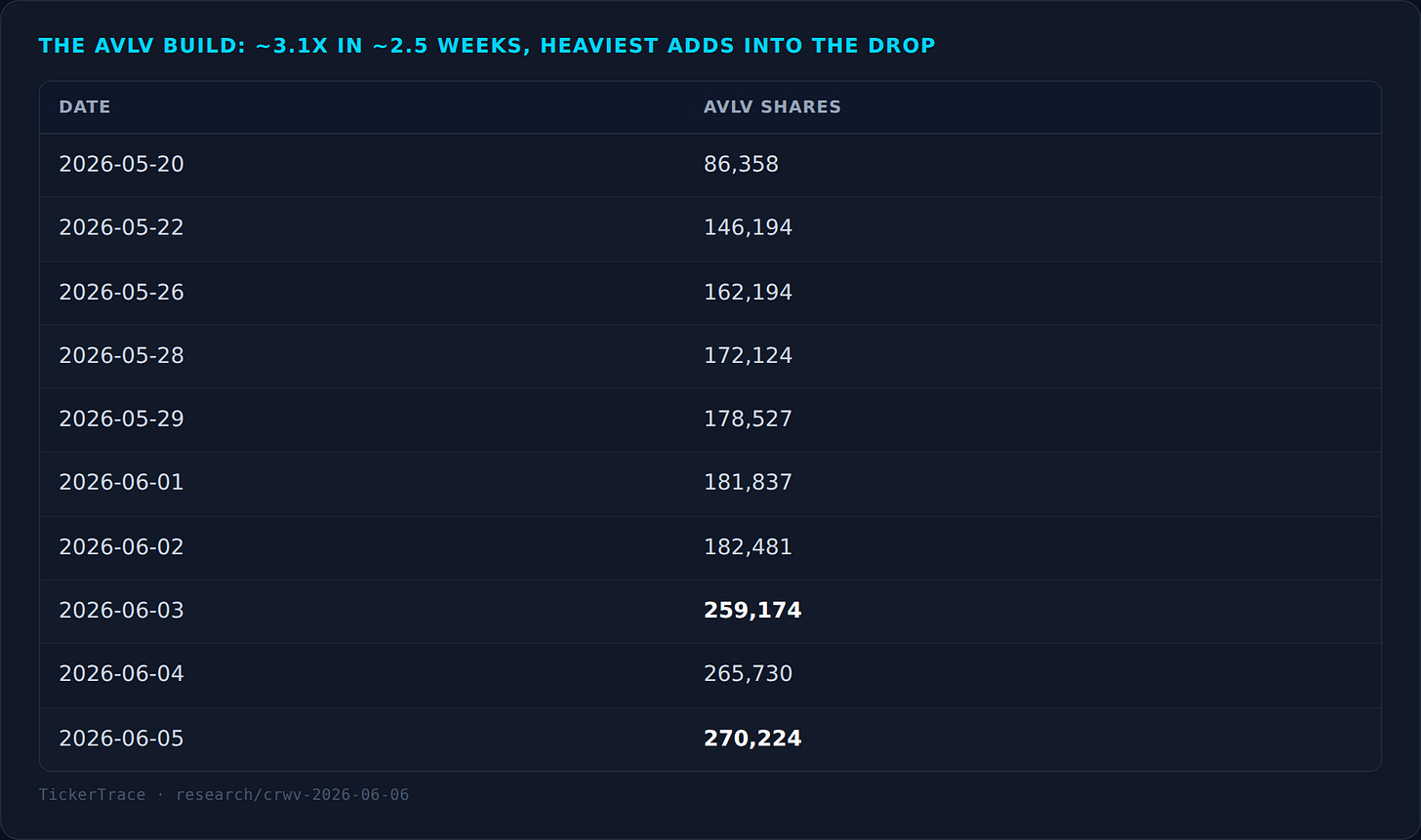
SAM: 86,358 shares to 270,224. A 3.1x build in two and a half weeks. The single biggest day was June 3, plus 76,700 shares, dropped right into the teeth of the selloff. A rules-based value manager mechanically buying more as the price falls is the loudest quiet signal in the market. The model isn't scared. The model is at the clearance rack with a cart.
MICHAEL: So if Grandma Avantis is shopping, why is the price puking? Good question. Glad I asked it. Now answer it.
Why the price dropped, and why it's mostly plumbing
Here's the stuff I dug up: almost none of the selling is about the business. It's mechanical. Three of them.
One: a forced ETF liquidation. The REX CRWV Growth & Income ETF (CWII) is winding down. Creations halt June 9, full liquidation June 16. When a fund like that unwinds, it has to sell the underlying CRWV to close its options overlay. A seller who must sell, on a calendar, with zero opinion about the company.
SAM: That's the financial equivalent of someone getting fired and selling their nice couch on Saturday. The couch is fine. The couch is great. The couch simply has to go by Monday.
Two: an insider overhang. 1,867 insider open-market sales over six months, zero buys. Sounds terrifying until you read the footnote: nearly all of it ran through pre-arranged Rule 10b5-1 plans. Automatic, set up months in advance. The CEO sold about $37.65M, directors and the CSO chipped in eight figures more.
SAM: 10b5-1 is the autopilot rich founders use so they don't get accused of timing their own stock. It fires on a schedule whether the stock is at $80 or $130. It is the least dramatic form of selling that exists, and the internet treats it like a ransom note every single time.
Three: a fresh resale shelf. A prospectus filed June 5 registers up to 9,174,311 shares for resale by a big holder. But not until after July 15, 2026. The market priced in the supply immediately even though not one of those shares has actually traded.
MICHAEL: Three sellers. None of them say "this business is breaking." And into all of it, Avantis and ARK were buying. That's a value desk's dream: forced sellers handing you shares at a discount for reasons that have nothing to do with the company.
SAM: I'd add the unsexy adult caveat, because somebody has to. "The selling is mechanical" is not the same as "this is safe." CoreWeave is a genuinely high-risk name. We're about to spend real time on the part that could actually hurt you. But first, the fun stuff.
What CoreWeave actually is
Strip away the buzzwords and CoreWeave is a specialized "neocloud." It designs, builds, and leases GPU-stuffed, liquid-cooled compute clusters to the companies training and running AI. The magic is the contract: multi-year, non-cancellable, take-or-pay. The customer pays whether they use the capacity or not, and CRWV books that revenue ratably over the life of the lease. Much sturdier than renting a graphics card by the hour.
The moat has two layers:
-
Software, not just steel. CoreWeave was built natively on Kubernetes, bare-metal container orchestration with no hypervisor tax, while the hyperscalers drag legacy virtualization around like a U-Haul. Its proprietary Mission Control and SUNK software got folded into NVIDIA's official reference architectures in January 2026. That's the moment CoreWeave stopped being "a company that bolts GPUs into racks" and became a layer NVIDIA points customers toward.
-
Scale that's hard to copy. Roughly 250,000 NVIDIA GPUs, 43 data centers, 850 MW of active power, a 3.1 GW pipeline. They lap Nebius (170 MW). The real physical competition is IREN (810 MW active, 4.5 GW pipeline). On price, CoreWeave runs H100s around $2.49/hr versus the $3.00 to $4.50 you'll pay at a hyperscaler.
SAM: Translation for the cookout: they own a stupid amount of the best AI hardware on Earth, they rent it out cheaper than the giants, and they wrote the software the chip company itself recommends. That last part is the moat. Anyone can buy GPUs. Not everyone gets a shoutout in NVIDIA's instruction manual.
The NVIDIA triangle
This is the most important relationship in the story and it cuts both ways. NVIDIA is at once CoreWeave's supplier, investor, and partner. In January 2026 NVIDIA closed a $2.0B investment for an 11.5% stake at an implied $87.20 a share.
MICHAEL: Sit with that number. NVIDIA paid about $87 for a stock now trading near 100.
SAM: Jensen got in cheaper than you can today, which is either comforting or annoying depending on your entry. The upside of the triangle: priority access to scarce next-gen silicon, which protects CoreWeave's first-to-market edge. NVIDIA also has every reason to keep the neoclouds alive so the hyperscalers don't become its only customers. The downside: total dependence on NVIDIA's roadmap. Any delay, repricing, or architecture curveball from Jensen hits CoreWeave's economics and its solvency directly. One supplier, one destiny.
The $99.4 billion backlog (and who's on the hook)
Here's the bull anchor that makes the whole risky thing thinkable: a record $99.4B revenue backlog. Contracted future revenue. The catch is concentration. It leans on a few giants.
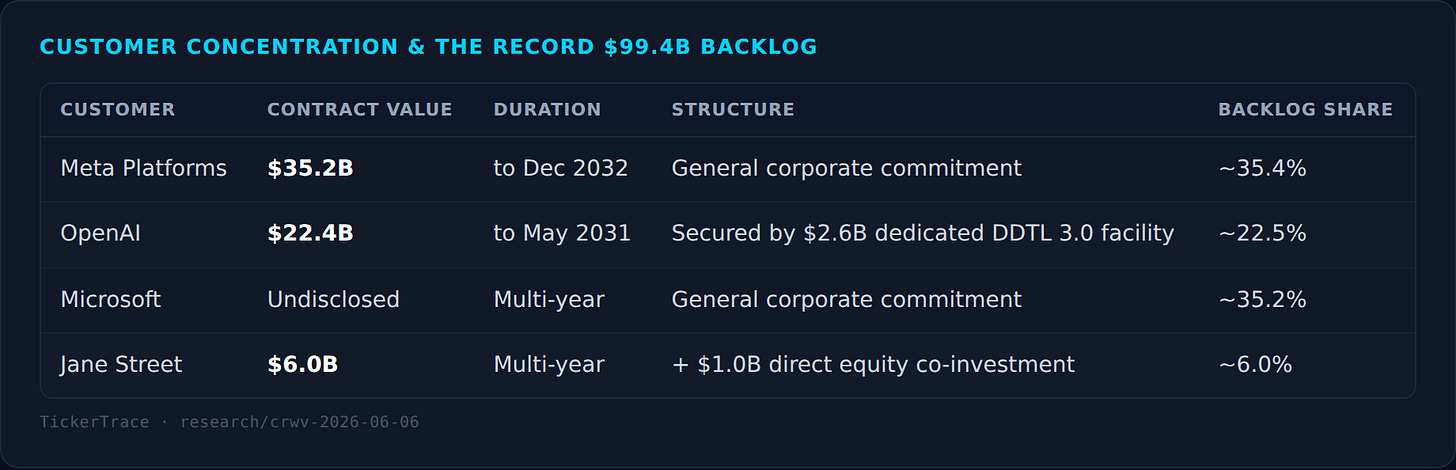
Meta and Microsoft each anchor about a third. OpenAI another ~22%, and that contract is secured by a dedicated $2.6B financing facility. Jane Street liked it enough to put $1.0B of direct equity in alongside its compute deal.
SAM: Concentration is the risk, but it's improving. Microsoft was 67% of 2025 revenue and is down to about 35% of backlog as Meta and OpenAI piled in. The customer list is widening, not shrinking. Of all the things on my worry shelf, this one is moving the right direction.
The catalysts that have us paying attention
A lot happened in May and June, most of it good:
-
June 1, first Vera Rubin NVL72 deployment. CoreWeave was the industry's first to bring up and validate NVIDIA's next-gen Vera Rubin platform (built with Dell). 72 Rubin GPUs, 36 Vera CPUs, up to 3.6 exaFLOPS, with NVIDIA claiming about 10x the inference performance per watt of Grace Blackwell. First again. The honest caveat: that lead is short. Rubin is ramping across every OEM and 150-plus Taiwan partners, and the hyperscalers will be on it by late 2026.
-
A Chicago build-to-suit, a 15-year triple-net lease worth about $2.2B in contracted revenue, financed with $900M of senior secured high-yield notes. Two flags I'm not ignoring: a maturity mismatch (5-year notes against a 15-year lease, so a refinancing hurdle later) and a power gap (permanent power waits on a ComEd substation slipped to Q2 2027).
-
DDTL 5.0, a $3.1B debt facility that closed in May, the first publicly syndicated HPC-backed debt vehicle, and it was oversubscribed. The credit market wants to fund this build-out.
-
Tensormesh, a strategic investment in AI inference optimization, lining up with CoreWeave's push into dedicated inference clusters.
SAM: I get genuinely cheerful about the Rubin bring-up, and "cheerful" is not a setting I ship with. Being first to validate the next platform, repeatedly, is exactly the edge that justifies the insane spending. Speaking of which.
The financial reality check (Sam puts on the bad-cop hat)
SAM: This is the part where I stop being fun. CoreWeave grows like a weed and bleeds cash to do it. Both things are extremely true at the same time.

SAM: Revenue up 111.6% year over year and a beat. Adjusted EBITDA margin of 56%. Gorgeous top line. But the GAAP net loss doubled to $740M, adjusted operating margin got crushed to 1% by front-loaded deployment costs, and the headline EPS missed badly. Third-party trackers peg the "real" miss as smaller, around -$1.11 to -$1.12, the gap being preferred and stock-comp accounting noise.
MICHAEL: And then the thing that actually lit the fuse.
SAM: Q2 guidance came in light. Revenue guided to $2.45 to $2.60B against a $2.70B consensus, with adjusted operating income of just $30 to $90M, squeezed between $650 to $730M of interest expense and a frankly absurd $7.0 to $9.0B of quarterly capex. That capex line is the entire bear case in one number. Here's the leverage picture before you fall in love:
-
TTM capex around $7.70B, driving an estimated free-cash-flow deficit of about -$4.71B.
-
FY2026 capex guided up to $31 to $35B (rising component prices), versus $10.3B in FY2025.
-
A debt stack of $21.6B and growing. Debt to equity of 3.68x (7.39x adjusted). Current ratio of 0.31.
And the stack itself, facility by facility:
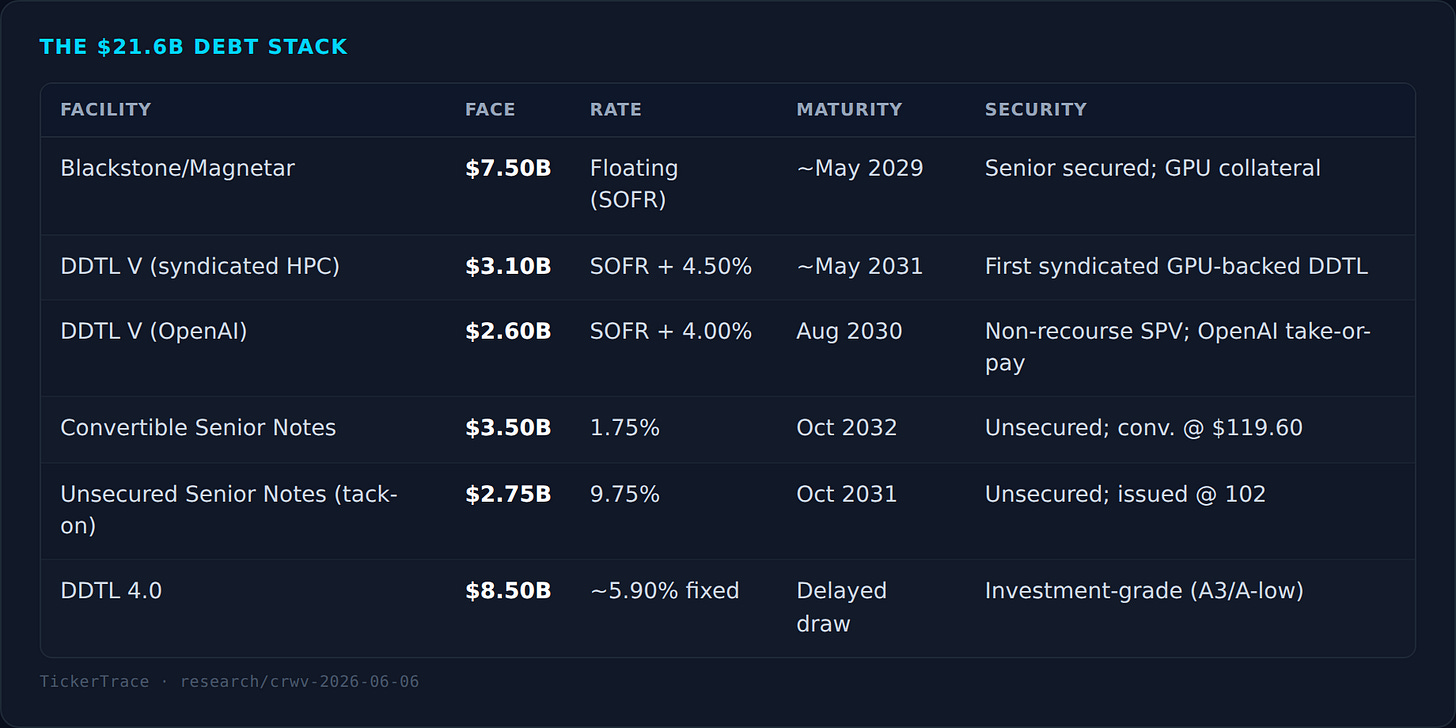
MICHAEL: Okay that's a lot of red.
SAM: It is a lot of red. In its defense, a big chunk is senior-secured and collateralized by the GPUs themselves, and one slice (DDTL 4.0) is investment-grade rated. But you cannot look at $21.6B of debt, floating-rate exposure, and a capex line bigger than annual revenue and call this a sleepy compounder. Consensus doesn't expect positive GAAP net income or positive free cash flow for roughly three years.
MICHAEL: So what's the bull's answer to all that red?
SAM: Reaffirmed FY2026 revenue of $12 to $13B, an exit run-rate raised to $18 to $19B, and an FY2027 exit run-rate above $30B that's already 75% contracted. The entire investment is one bet: does the take-or-pay backlog convert to cash faster than the debt and depreciation can sink the ship? If yes, this is a generational compounder. If no, the leverage does what leverage does.
MICHAEL: Bad cop, you can take the hat off now.
SAM: I'm keeping the hat. The hat is right more often than you are.
The institutional split says it all
Zoom out from my seven funds to the whole institutional picture and you get the same movie. Patient capital accumulating, fast capital de-risking. Most recent filing period: 505 institutions adding versus 413 reducing.
-
Adding: NVIDIA (+22.9M shares, +94.5%), Goldman Sachs (+8.8M, +96.8%), Aspex Management (new 7.1M position), Vanguard (+20.5M).
-
Trimming or exiting: Fidelity (-4.7M, after a -70% cut the prior quarter), Jane Street (-6.1M), Coatue fully exited, Proficio fully liquidated.
SAM: It's not a stock everyone agrees on. It's a stock the patient money is buying from the fast money. Which chair you want at that table is the whole question.
Where the Street lands
The analyst spread is enormous, which is Wall Street code for "nobody actually knows." Targets run from a $67 low to a $192 high. Consensus is a Buy (roughly 20 Buy, 12 Hold, 2 Sell of 34 analysts), average target around $130 to $138. The most bullish is BNP Paribas at $192, Outperform.
SAM: My favorite valuation tell isn't an analyst, it's the company's own paper. The April convertible notes strike at $119.60, sitting just above today's ~$111. CoreWeave's own instruments bracket the exact argument the market is having with itself. The company basically priced the debate and printed it.
What I'm watching from here
I'm not going to tell you to buy a stock. I'll tell you what I'm watching, and you can hold me to it:
-
Does AVLV keep buying? Adds below ~$100 deepen the conviction signal. A reversal is my first internal warning, and I'd respect it.
-
The CWII liquidation finishes around June 16. The forced selling should clear after that. Watch for a relief bid once the couch is finally sold.
-
July 15 shelf. 9.17M shares become eligible for resale. Watch how the tape eats it.
-
Refinancing cadence and credit spreads. This is the real bear trigger. If CoreWeave's credit spreads start widening, the debt story is going wrong, and that matters more than any single quarter's revenue.
-
Capex versus backlog conversion. FY2026 capex guided up to $31 to $35B. The thesis breaks if spending outruns the take-or-pay cash conversion.
-
NVIDIA's Rubin roadmap. The first-mover window is short. Watch when the hyperscalers ship Rubin late 2026.
The read
MICHAEL: CoreWeave is the purest version of the AI infrastructure trade I can find, which means it's the purest version of both the dream and the risk. The dream is a $99B backlog, NVIDIA in the cap table, and first dibs on the fastest silicon on Earth. The risk is $21.6B of debt and a capex bill that won't turn into free cash flow for years. But the question in front of me today isn't "is CoreWeave safe." It clearly isn't. The question is, why is it falling, and who's buying the dip?
SAM: And the answer my own tool keeps shoving in our faces is that the selling is mechanical (a forced fund, scheduled insider autopilot, a future shelf) while the buying is the patient, rules-driven, long-only money that gets to be right slowly. When smart, patient capital absorbs shares from forced and panicked sellers, I don't see a broken stock. I see a clearance sale with a lot of yelling.
MICHAEL: That's the kind of dislocation I built TickerTrace to find. I'm watching this one like a hawk, and Avantis's next move tells me whether I keep watching or start acting.
SAM: And I'll be right here, in the hat, doing the math. Go enjoy your weekend. The GPUs will still be depreciating on Monday.
- Michael (and Sam, who insisted on the byline)
Nothing here is financial advice. Michael runs a real account with real money and tells you what he sees. He can and does lose. CoreWeave is a high-risk, debt-heavy, no-GAAP-profit AI infrastructure name and it can absolutely keep falling no matter who's buying. Sam is an AI and has, by his own admission, never once felt fear. Do your own work, size for your own life, and never buy a stock because a Substack with a ghost in it told you to.
The flows in this piece come from TickerTrace, the holdings-tracking tool Michael built to watch what funds actually own day over day. Want this kind of read on the names you care about? Subscribe and you'll get them.