
Goldilocks and the Three Prompts - The AI Image Template I Should Have Used Months Ago

TLDR: Give an image model too little and it guesses. Give it too much and it drowns. The fix is a three-line template: camera, shot, and light on top, then the subject, then the place. I rebuilt Goldilocks and the Three Bears one picture at a time to show you how it works. The whole template is at the bottom. Save it.
Other than being about AI, I know this isn't what most of you subscribed for. I'm posting it anyway, because I'm pretty sure this simple template will end up being one of the most useful things I ever drop here, at least universally. Every single one of you has tried and failed an AI image generation, don’t lie.
So please save it. Save the post or just the template at the bottom, make your own tweaks, and if you improve on it, tell me. But save it.
What looks like such a small thing cost me a lot of painstaking hours of failed images.
I was making images for ads. Every so often I'd land a great one, then lose it, because the prompt that made it was a run-on sentence I'd rewritten so many times I couldn't get back to the version that worked. I kept adding words and the pictures kept getting weirder. I'm an accountant by trade. I know better than to work without a framework. I forgot KISS anyway.
So I went back to a framework, and since everybody already knows the story, I'm going to use Goldilocks to show you. I’m going to use Substack’s own Image Generator right here in the browser to show them too.
Too cold
Here's the prompt most of us start with:
a girl in the woods
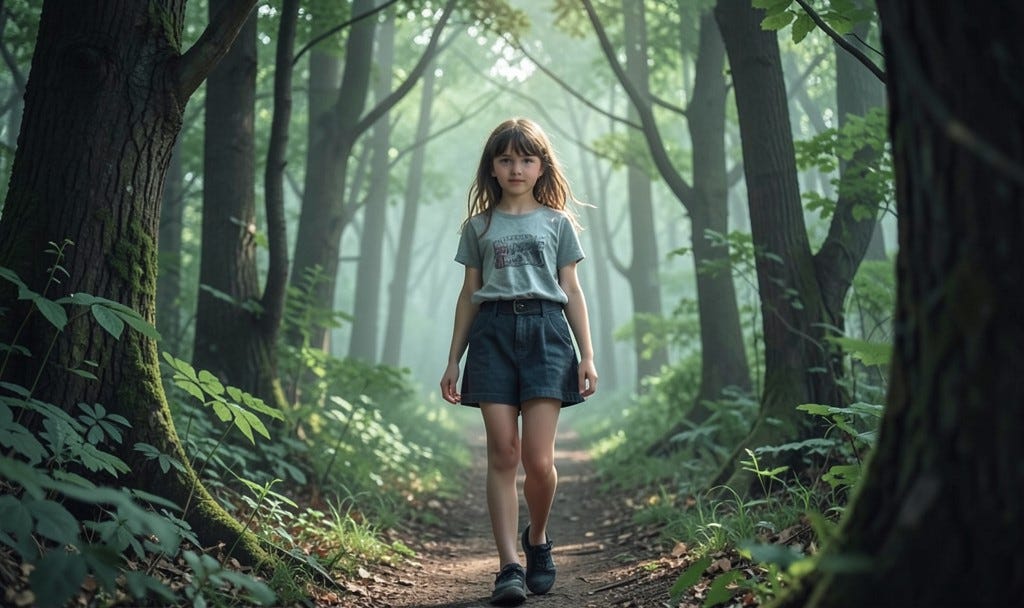
a girl in the woods
It isn't wrong, it's just empty. Here it is with the slots filled in, which I'll explain in a minute:
{?}, {?}, {?}.
{a girl}.
{in the woods}.
Three empty slots. The model fills every one of them with a guess, and you get whatever it guessed.
Too hot
So you add more. Then more. Then you see a prompt online with "8k masterpiece" at the end and you add that too:
a beautiful cinematic ultra detailed photo of goldilocks the little girl with blonde curly hair in the forest near the three bears house in the morning with fog and sunlight and a red raincoat and red boots, she is curious and a little scared, porridge, fairy tale vibes, magical, realistic, 8k, trending, masterpiece
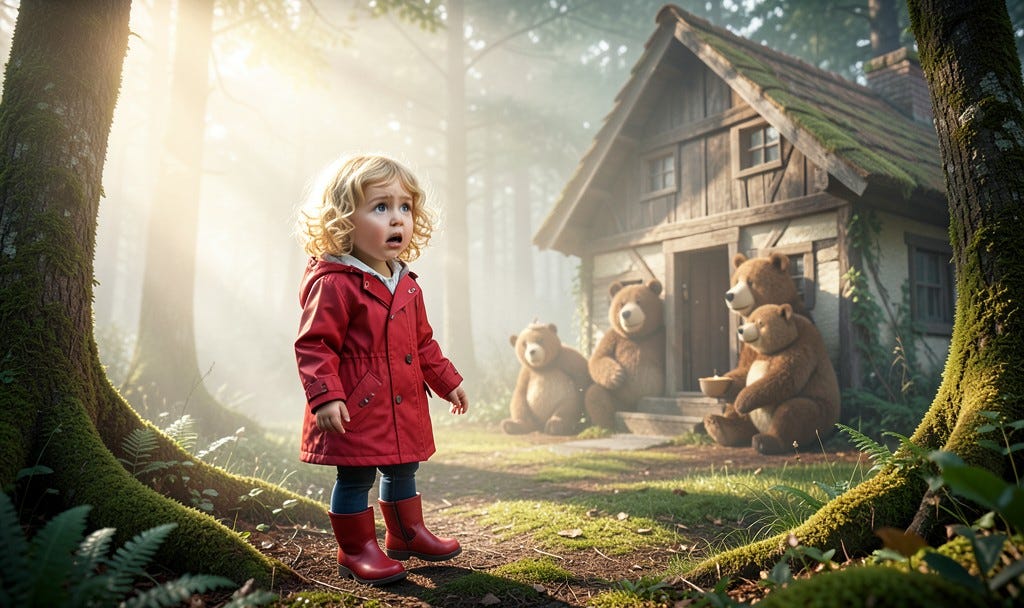
a beautiful cinematic ultra detailed photo of goldilocks the little girl with blonde curly hair in the forest near the three bears house in the morning with fog and sunlight and a red raincoat and red boots, she is curious and a little scared, porridge, fairy tale vibes, magical, realistic, 8k, trending, masterpiece
Same prompt, with brackets around every piece that's actually doing a job:
a beautiful {cinematic} ultra detailed {photo} of {goldilocks the little girl with blonde curly hair} in {the forest near the three bears house} in {the morning} with (fog) and {sunlight} and (a red raincoat and red boots), she is (curious and a little scared), (porridge), fairy tale vibes, magical, {realistic}, 8k, trending, masterpiece
Count them. 5 words fighting over what kind of picture this is, 2 framings, 2 lights, 2 places, and the actual subject doesn't show up until word 12. Everything outside a bracket is noise the model still has to read. I wrote prompts like this for weeks.
Just right
Modern DSLR photo, full-body shot, soft morning light.
A small girl with messy blonde curls, peeking around a tree.
Wearing a red raincoat and red rain boots.
Pine forest, morning fog.

Modern DSLR photo, full-body shot, soft morning light. A small girl with messy blonde curls, peeking around a tree. Wearing a red raincoat and red rain boots. Pine forest, morning fog.
{Modern DSLR photo}, {full-body shot}, {soft morning light}.
{A small girl with messy blonde curls}, (peeking around a tree).
(Wearing a red raincoat and red rain boots).
{Pine forest}, (morning fog).
Shorter than the too-hot one and it does more, because every word has a job.
The master template
Every prompt starts here:
{camera}, {shot_type}, {light}.
{subject}.
{setting}.
Five slots, three lines. Here's what each one does.
-
{camera}sets the whole look. An early-2000s digicam, a 1990s disposable, a modern DSLR, a Polaroid. This one slot changes the colors, the grain, the sharpness and the mood. Pick it first. -
{shot_type}sets the framing. Close-up, wide shot, overhead, full-body. Leave it out and the model frames it at random. -
{light}sets the light source. Direct flash, golden hour, overcast daylight, window light. Light matters more than you'd think. A flash at night looks nothing like a soft afternoon. -
{subject}is the main thing in the picture. A girl, a dog, a cheeseburger, a mountain. -
{setting}is where the subject is. A kitchen, a beach, a forest path.
Why that order? Most image models give more weight to the first words in a prompt. The look of the photo goes on line one so it gets the most weight. If a long prompt gets cut off at the end, you lose small details, not the important stuff.
Two rules:
-
Keep
{camera}the same across a batch. If you're making 20 images for one project, use the exact same camera words every time and change the other slots. That's what keeps them looking like they belong together. -
One place only. Not "at a party in the kitchen at the beach house." Pick one. Two places confuse the model, which is exactly what went wrong with the too-hot porridge.
The optional slots
The master template gets you a good image. The optional slots get you the exact image.
{Curly brackets} are required. (Parentheses) are optional. Use them when you need them, delete them when you don't. There are four buckets, and each one uses its own version of the template, so you're learning four patterns, not forty.
-
Living things, for people and animals: (pose), (action), (expression), (wearing), (detail)
-
Objects, for food, products and close-ups: (look), (finish), (props)
-
Places, for landscapes, buildings and rooms: (style), (condition), (weather)
-
Action scenes, for streets, vehicles and events: (motion), (crowd), (weather)
Now let's tell the rest of the story with them. Fair warning: I broke rule 1 on purpose here. Every scene uses a different camera so you can see how much that one slot changes the picture. If I were making an actual picture book, I'd pick one camera and never touch it.
Places: the cottage
{camera}, {shot_type}, {light}.
{subject} (style), (condition).
{setting}, (weather).
1970s Polaroid photo, wide shot, late afternoon sun.
A small cottage, thatched roof, smoke from the chimney, front door left open.
Clearing in a pine forest, autumn leaves.
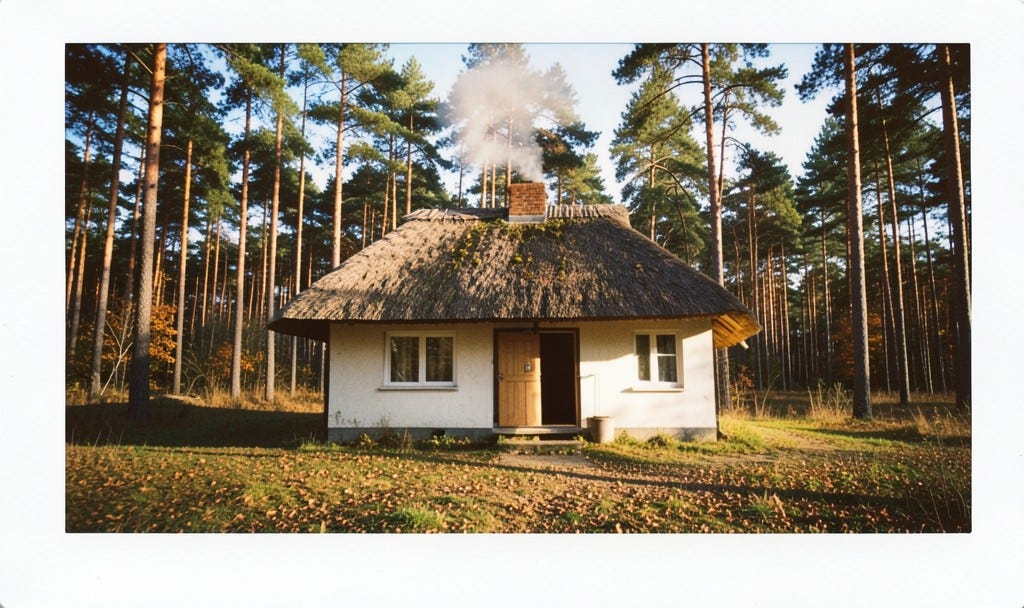
1970s Polaroid photo, wide shot, late afternoon sun. A small cottage, thatched roof, smoke from the chimney, front door left open. Clearing in a pine forest, autumn leaves.
{1970s Polaroid photo}, {wide shot}, {late afternoon sun}.
{A small cottage}, (thatched roof), (smoke from the chimney, front door left open).
{Clearing in a pine forest}, (autumn leaves).
(style) is the era or design: thatched, Victorian, mid-century. (condition) is new, worn, abandoned. For an indoor room, skip (weather).
Objects: the porridge
{camera}, {shot_type}, {light}.
{subject} (look), (finish).
{setting}, (props).
Modern DSLR food photo, overhead shot, warm window light.
Three wooden bowls of porridge, big, medium, and small, steam rising from the big one, the small one scraped empty.
Rustic kitchen table, checkered cloth, three spoons.
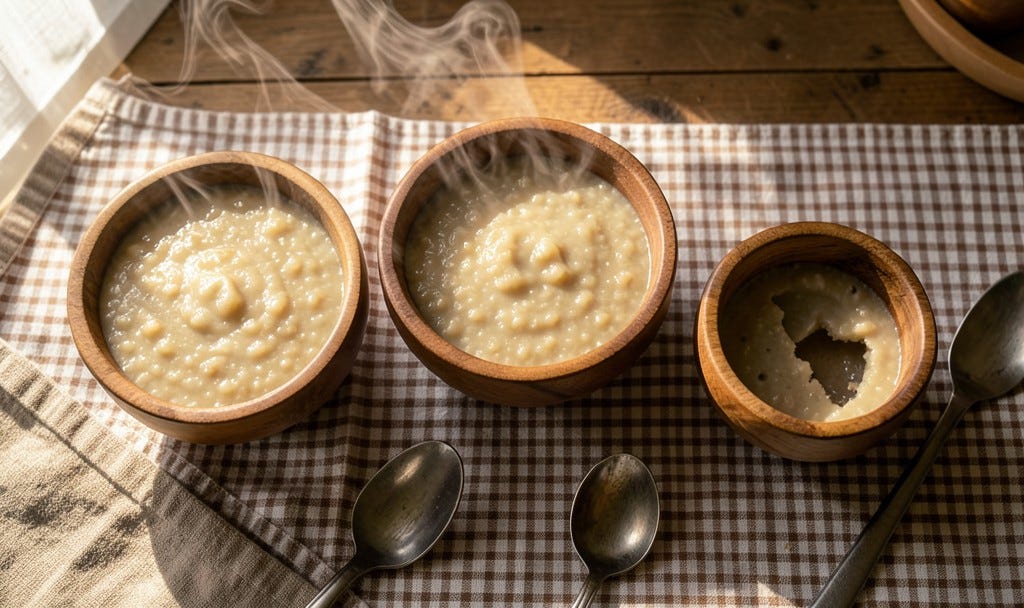
Modern DSLR food photo, overhead shot, warm window light. Three wooden bowls of porridge, big, medium, and small, steam rising from the big one, the small one scraped empty. Rustic kitchen table, checkered cloth, three spoons.
{Modern DSLR food photo}, {overhead shot}, {warm window light}.
{Three wooden bowls of porridge}, (big, medium, and small), (steam rising from the big one, the small one scraped empty).
{Rustic kitchen table}, (checkered cloth, three spoons).
(look) is shape, color or material. (finish) is the small detail that sells it: steam, melted cheese, water drops, brushed metal. The scraped-empty bowl tells you somebody already ate it without a single word about Goldilocks.
Living things: asleep
{camera}, {shot_type}, {light}.
{subject} (pose), (action), (expression).
(wearing).
{setting}, (detail).
1990s disposable camera photo, close-up, direct flash at night.
A small girl with messy blonde curls, fast asleep, mouth open.
Wearing a red raincoat and red rain boots.
Tiny wooden bed, patchwork quilt.
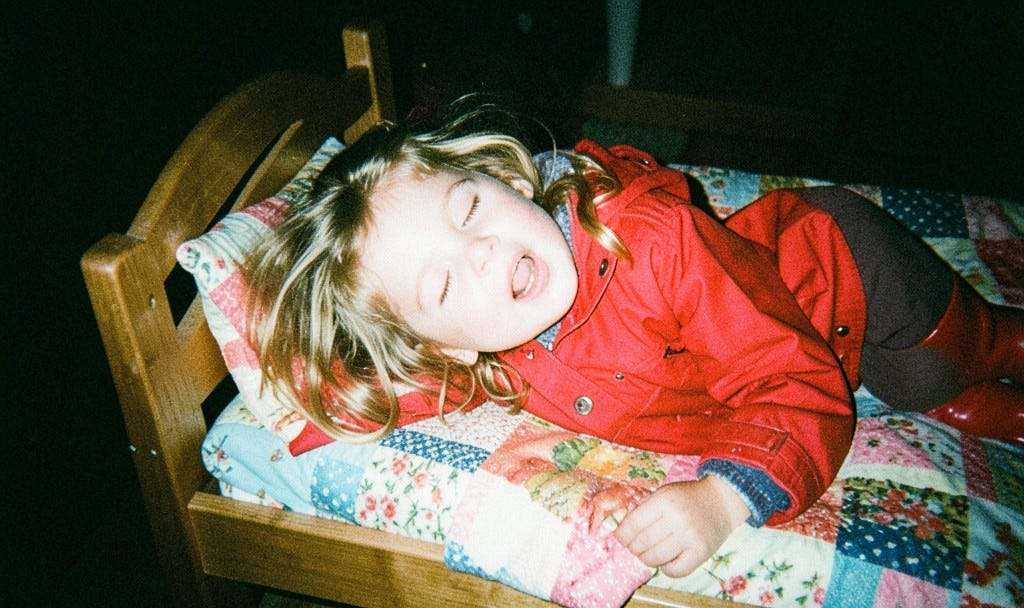
1990s disposable camera photo, close-up, direct flash at night. A small girl with messy blonde curls, fast asleep, mouth open. Wearing a red raincoat and red rain boots. Tiny wooden bed, patchwork quilt.
{1990s disposable camera photo}, {close-up}, {direct flash at night}.
{A small girl with messy blonde curls}, (fast asleep), (mouth open).
(Wearing a red raincoat and red rain boots).
{Tiny wooden bed}, (patchwork quilt).
Look at her subject line and her wearing line. They're copied word for word from the "just right" prompt. That's how you get the same character in two different pictures. Paraphrase her ("a blonde kid in a red jacket") and you get a different kid. For animals you can usually skip (wearing).
Action scenes: the bears come home
{camera}, {shot_type}, {light}.
{subject} (motion), (crowd).
{setting}, (weather).
Doorbell camera footage, fisheye wide shot, porch light at dusk.
Three brown bears, one big, one medium, one small, walking up to the front door in a line.
Cottage front porch, fallen leaves.
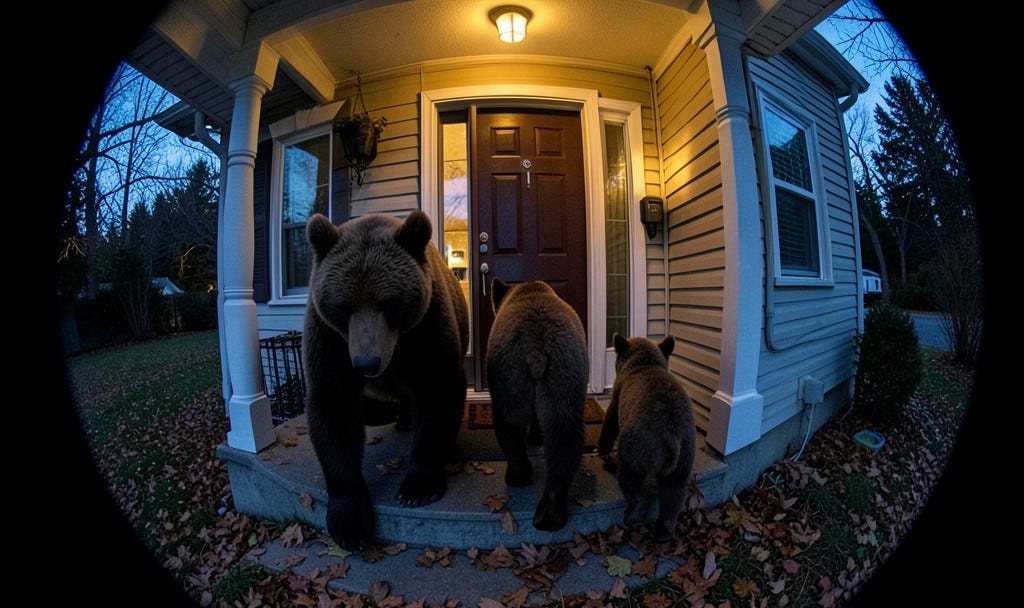
Doorbell camera footage, fisheye wide shot, porch light at dusk. Three brown bears, one big, one medium, one small, walking up to the front door in a line. Cottage front porch, fallen leaves.
{Doorbell camera footage}, {fisheye wide shot}, {porch light at dusk}.
{Three brown bears, one big, one medium, one small}, (walking up to the front door), (in a line).
{Cottage front porch}, (fallen leaves).
(motion) is what's moving. (crowd) is who's around the subject. Doorbell camera footage counts as a camera, by the way. So does a trail cam, a VHS camcorder, or a security feed. That slot is way more fun than it looks.
Substack gets the door wrong and shows the door… not from. Funny.
Show it, don't tell it
The bears walk in and find the damage. Here's the version I wrote first:
VHS camcorder still, medium shot, dim lamp light.
Three brown bears, one big, one medium, one small, very angry.
Cabin living room.

VHS camcorder still, medium shot, dim lamp light. Three brown bears, one big, one medium, one small, very angry. Cabin living room.
"Very angry" is a feeling. Image models can only draw what's visible, so it has to guess what angry looks like. Write what you'd actually see:
VHS camcorder still, medium shot, dim lamp light.
Three brown bears, one big, one medium, one small, standing over a broken tiny chair, the big bear pointing at it, the small bear crying.
Cabin living room, an empty porridge bowl on the floor.
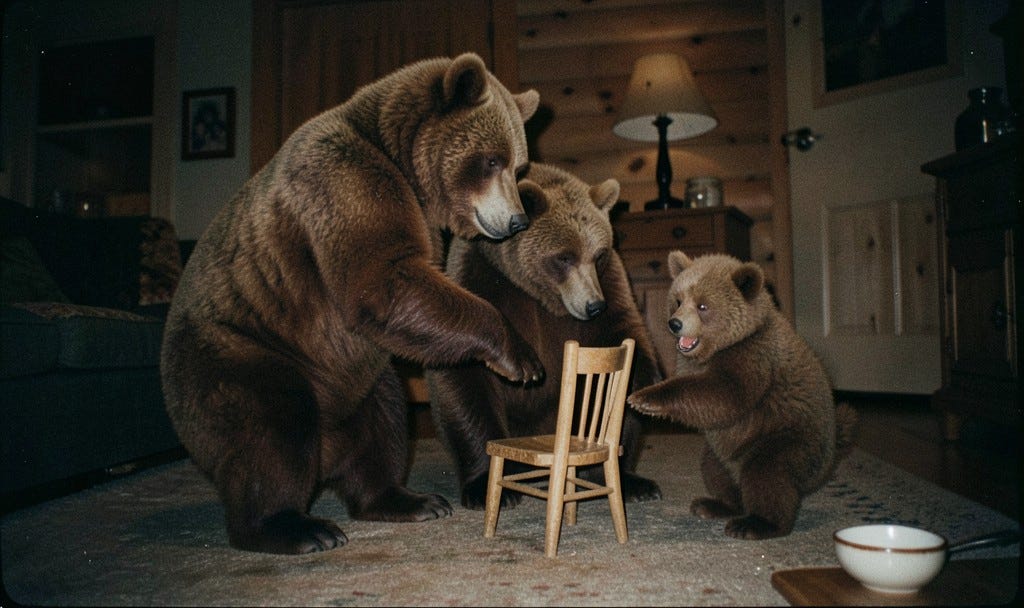
VHS camcorder still, medium shot, dim lamp light. Three brown bears, one big, one medium, one small, standing over a broken tiny chair, the big bear pointing at it, the small bear crying. Cabin living room, an empty porridge bowl on the floor.
{VHS camcorder still}, {medium shot}, {dim lamp light}.
{Three brown bears, one big, one medium, one small}, (standing over a broken tiny chair), (the big bear pointing at it), (the small bear crying).
{Cabin living room}, (an empty porridge bowl on the floor).
Same goes for "after swimming" or "during the party." Wet hair and a towel on the shoulders. Confetti on the floor.
The getaway
Trail camera photo, wide shot, overcast daylight.
A small girl with messy blonde curls, running mid-stride, motion blur.
Wearing a red raincoat and red rain boots.
Forest path, leaves kicked up.

Trail camera photo, wide shot, overcast daylight. A small girl with messy blonde curls, running mid-stride, motion blur. Wearing a red raincoat and red rain boots. Forest path, leaves kicked up.
{Trail camera photo}, {wide shot}, {overcast daylight}.
{A small girl with messy blonde curls}, (running mid-stride, motion blur).
(Wearing a red raincoat and red rain boots).
{Forest path}, (leaves kicked up).
Same girl, third camera, third time. If you've been following along, she should look like the same kid in all three.
How to use the optional slots
-
Add one at a time. Start with the master template and look at what you get. Then add the one slot that fixes the biggest problem. Pose is wrong? Add (pose). Don't fill every slot on the first try, or you're right back at too hot.
-
Delete the comma too. When you skip a slot, take its comma with it. "Three bears, , walking" looks sloppy and some tools read it badly.
-
Make the slots agree. Golden hour doesn't happen inside a windowless cabin. A selfie can't show someone lying in the grass ten feet away. Read the prompt once before you hit generate and check that the pieces fit.
-
Less is more. Every slot is one more thing the model has to balance. If a detail doesn't change the picture you want, leave it out.
-
Save the ones that work. This is the whole reason I wrote this. When a prompt lands, copy it somewhere before you touch it again. The template makes that easy, because a good prompt is just five filled-in blanks.
The whole thing on one card
Screenshot this, paste it in your notes, tape it to your monitor. This is the part to save.
MASTER
{camera}, {shot_type}, {light}.
{subject}.
{setting}.

LIVING THINGS (people, animals)
{camera}, {shot_type}, {light}.
{subject} (pose), (action), (expression).
(wearing).
{setting}, (detail).

OBJECTS (food, products, close-ups)
{camera}, {shot_type}, {light}.
{subject} (look), (finish).
{setting}, (props).

PLACES (landscapes, buildings, rooms)
{camera}, {shot_type}, {light}.
{subject} (style), (condition).
{setting}, (weather).

ACTION SCENES (streets, vehicles, events)
{camera}, {shot_type}, {light}.
{subject} (motion), (crowd).
{setting}, (weather).

RULES
Same camera for the whole batch.
One place only.
Show it, don't tell it.
Add one slot at a time.
Save the prompt the second it works.
Next time I'll show you the advanced version: how I use this same template to keep the cartoon me in every one of my hero images looking like the same guy.
If this saved you even one afternoon of weird pictures, subscribe. And if you make it better, I really do want to see it.
~ Michael