Loading...

Options Flow deep dive · 20 min read
How to Read the Earnings Flow Scanner
A full walkthrough of every card field, filter, and signal window on the Earnings Flow Scanner, covering the IV mechanics that make earnings options different from everything else.
Open the tool →Hey guys, Art from TraderMatrix here. If you've been using the Unusual Activity feed for a while, you've probably noticed that flow heats up around earnings. Tickers get active, sweeps start flying, and names you hadn't thought about show up with seven-figure premiums. The Earnings Flow Scanner is where all of that gets organized: one filtered view showing only the names where unusual flow has built up AND a report is coming within the next three weeks.
That's the thing that makes this page different from the regular flow feed. The Unusual Activity scanner covers the full universe all the time. It's huge and intentionally noisy. This one was 36 results out of 54 on the day I'm writing this (October 1, 2026, after the close). Smaller list, specific filter: unusual activity in the last 30 days, earnings inside 21 days, both conditions true at once. One thing to be clear about before you go further: nothing on this page predicts outcomes. It shows you what other traders and institutions have been doing with options, how early they did it, and what the market has priced in for the event.
The short version:
- A name only appears when it had unusual options flow in the past 30 days AND reports within the next 21 days. Both conditions at once.
- EARLY prints (14+ days before the report) carry the most weight in the Conviction formula. They are the clearest tell of deliberate pre-earnings positioning.
- Conviction measures how committed and how early the directional lean was. A high raw split with low Conviction usually means late-window noise, not a thesis.
- The expected move is a hurdle: a directional bet needs the stock to clear that percentage in the right direction to pay off.
- IV crush on report resolution is the normal outcome. The pre-earnings trade and the through-earnings trade are different bets with different math.
What the page actually covers
The title is "Earnings Flow Scanner." The subtitle reads: "Pre-earnings options flow for tickers with recent unusual activity (next 21 days)." That look-ahead window is fixed at 21 days on the live page. The lookback for unusual activity is 30 days. A name only appears when both conditions are true: it had unusual flow in the past 30 days, and it's reporting within the next three weeks.
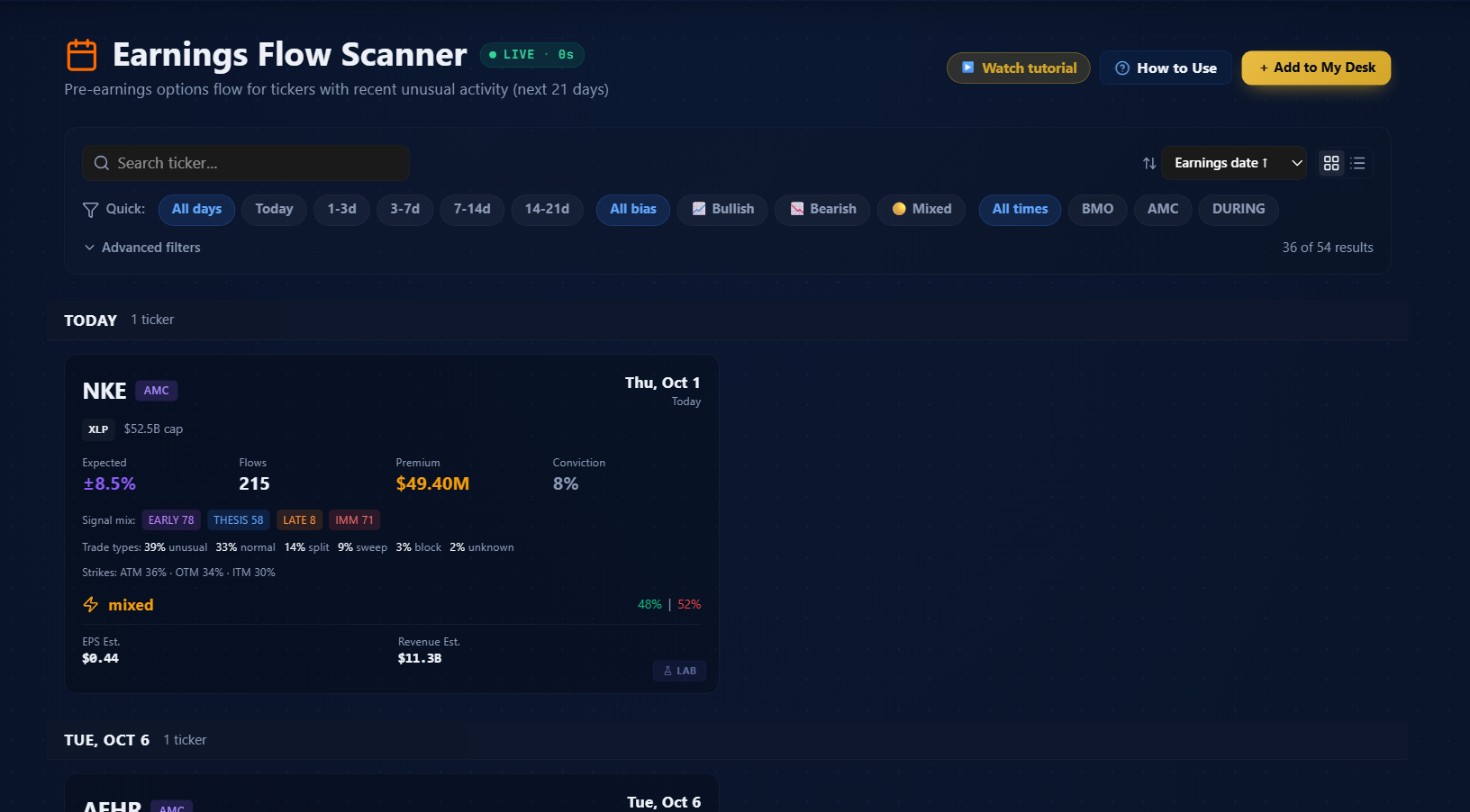 The full scanner showing 36 of 54 results, grouped by earnings date. NKE is in the TODAY group, reporting after the close.
Cards group by report date. Scroll down and you see: TODAY, TUE OCT 6, WED OCT 7, THU OCT 8, TUE OCT 13, WED OCT 14 and on through the window. That grouping makes clusters immediately visible. The Oct 13-14 section in this screenshot has a full XLF stack: WFC, BAC, MS and a couple more, all reporting in a two-day window.
At the top right: Watch tutorial, How to Use, and + Add to My Desk. The "How to Use" sidebar is the in-app quick reference. "Add to My Desk" drops this scanner as a tile on your personal dashboard.
Filters: quick access and sort
Sort control. Five options: Earnings date (default), Premium, Flow count, Confidence, Expected move. I leave it on Earnings date almost always. Sorting by Premium during active earnings weeks surfaces where the concentrated money is, which can be useful once you've already located what's reporting when.
Quick date buckets. All days, Today, 1-3d, 3-7d, 7-14d, 14-21d. Hit 1-3d and the list collapses to names reporting in three days or fewer. Most of my active work happens in this window.
Bias filter. All bias, Bullish, Bearish, Mixed. The labels match the consensus sentiment on each card. Bullish means 65% or more of the weighted flow landed on the bullish side. Bearish is the mirror (65% bearish). Mixed is the 35-65% range where the flow didn't land cleanly on either side. A 63/37 split reads "Mixed," not "Bullish." That threshold matters.
Report timing. All times, BMO, AMC, DURING. Before market open, after the close, intraday. AMC names have until Friday afternoon for a clean entry before the number drops. BMO names are already done by the time the open prints.
Grid vs. list. The toggle at the top right of results. Grid is two columns; list is single column. Grid for a quick board scan, list when I want to read one card carefully.
Advanced filters
Click "Advanced filters" and a second row opens.
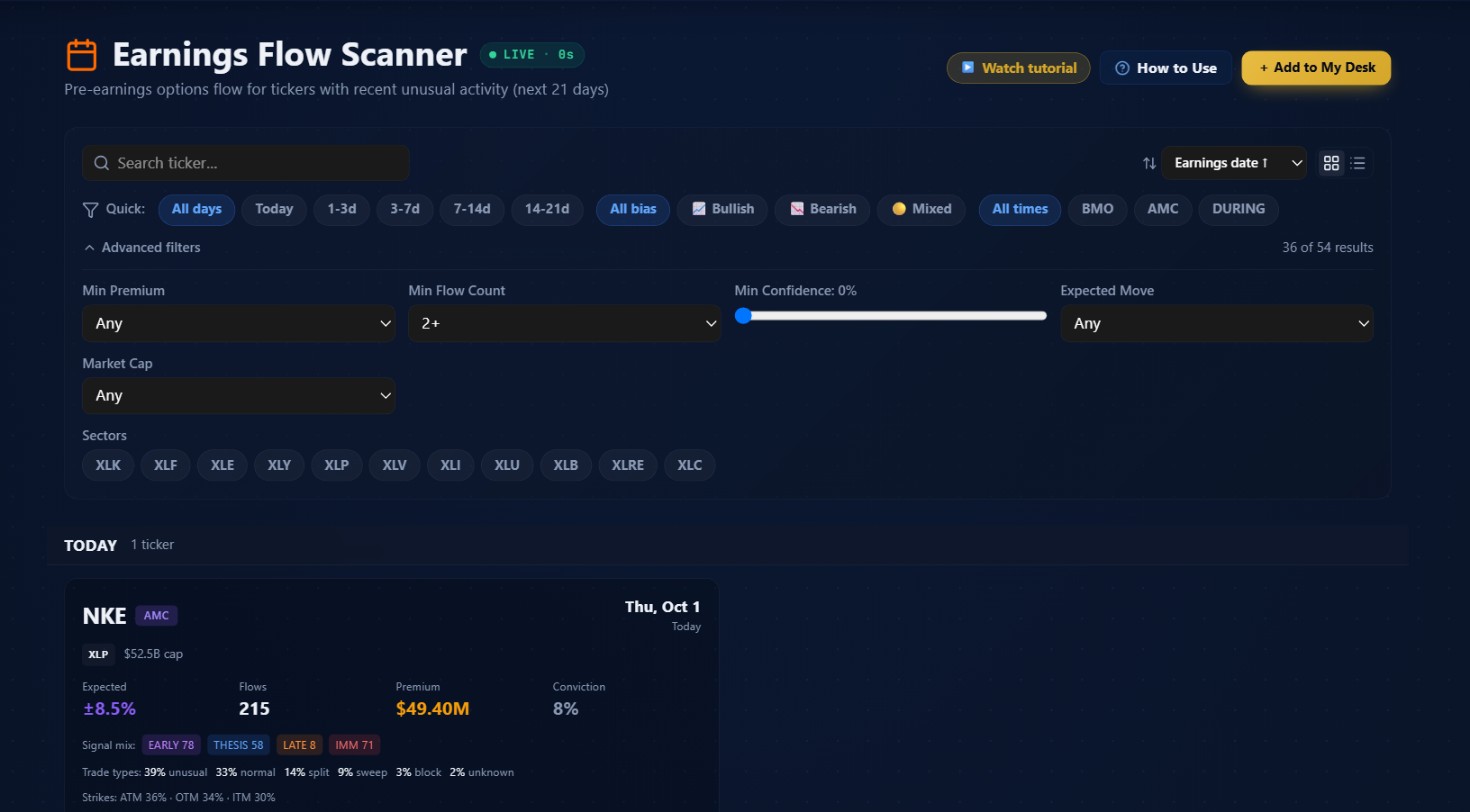 The full filter set: a confidence slider from 0-100%, expected move range, three market cap buckets, and all 11 sector ETF chips.
Min Premium. Dropdown with dollar thresholds. Setting this to $5M filters out thin-money names quickly. Most of my analysis focuses on names where the aggregate pre-earnings premium is meaningful.
Min Flow Count. Default is 2+. This counts individual prints, not dollar total. A $10M position could be a single block. Fifty prints totaling $10M is a different picture of how the positioning came together.
Min Confidence. A slider, 0-100%. This filters by what the cards label "Conviction" (the formula is covered below). Sliding to 50 removes the ambiguous names and shows only those with a real directional lean in the weighted flow.
Expected Move. Range selector. Useful when you want to compare setups with similar-sized implied moves, or when you specifically want names with wide expected moves.
Market Cap. Mega-cap (above $200B), Large-cap ($10B-$200B), Mid-cap ($2B-$10B). On bank earnings week, mega-cap immediately isolates the large names from the regional banks.
Sectors. Eleven chips: XLK, XLF, XLE, XLY, XLP, XLV, XLI, XLU, XLB, XLRE, XLC. Click one to filter to that sector. Hit XLF during Oct 13-14 and the bank cluster appears alone.
Try this: At the start of each earnings week, set Min Confidence to 50 and Min Premium to $5M. That collapses the scanner to cards with real dollar size and a directional lean. Then scroll by date to see which days have the most concentrated setups.
Reading the NKE card
Let me walk through a real card from the live page. NKE reported Thursday, October 1 after the close (that's the AMC badge next to the ticker). Sector XLP, market cap $52.5B.
Expected: +/-8.5%. Computed from the at-the-money straddle midpoint (or the nearest OTM strangle when spot sits between strikes), using an expiration dated just after the report, divided by the stock price. This is what the options market is charging for the uncertainty of this event. A directional options play on NKE needs the stock to clear 8.5% in the right direction to pay off properly. Not just move. Beat that number.
Flows: 215. Two hundred fifteen individual prints registered as unusual activity in the 30-day window. That's a heavily trafficked name in the lead-up to a quarterly report.
Premium: $49.40M. Total dollar value of options premium across those 215 prints. Forty-nine million in pre-earnings positioning is significant.
Conviction: 8%. Honestly, this number surprises people the first time they see it on a card with $49M of flow. The formula: take the weighted bullish percentage across all prints, where each print's weight depends on its signal window (1.5x for EARLY, 1.2x for THESIS, 1.0x for LATE and IMMINENT). Call that weighted percentage W. Then Conviction = absolute value of (W minus 50), multiplied by 2.
NKE's split is 48% bullish, 52% bearish, essentially a coin flip. Abs(48-50) x 2 = 4. After weighting, the consensus number works out to 8%. The card labels it "mixed" and shows the 48%|52% split at the bottom. When something scores 8% Conviction on $49M of pre-earnings premium, the message is plain: the market is split. The positioning is two-sided going into this print.
Signal mix: EARLY 78, THESIS 58, LATE 8, IMM 71. This is the line I read before anything else after Expected Move. Every print is tagged by how far before the report it was detected:
- EARLY: 14 or more days out (weight 1.5x in the consensus math)
- THESIS: 7-13 days out (1.2x)
- LATE: 3-6 days out (1.0x)
- IMM: 0-2 days out (1.0x)
NKE has 78 EARLY, 58 THESIS, 8 LATE, 71 IMMINENT. That 71 IMM count means a large chunk of the 215-print total landed in the last two days before the report: last-minute money at peak implied volatility.
Trade types: 39% unusual, 33% normal, 14% split, 9% sweep, 3% block, 2% unknown. How the prints were structured. Sweeps and blocks are aggressively-priced executions that flag as unusual. Splits are large orders broken across exchanges. The 39% unusual rate is high.
Strikes: ATM 36%, OTM 34%, ITM 30%. Where flow landed relative to the current price. NKE's distribution is spread fairly evenly across all three, which doesn't indicate a strong directional lean on its own.
Mixed 48%|52%. The raw bull/bear split at the bottom of the card. Just barely above 50/50 bearish, well inside the mixed threshold.
EPS Est: $0.44, Revenue Est: $11.3B. Wall Street consensus estimates from the earnings calendar feed. Context for interpreting the flow: if you're seeing bearish positioning on a name expected to post strong numbers, it's worth understanding whether those puts are a bet against the quarter or a hedge against held stock.
LAB link. The small icon at the bottom right of every card. Click it and Ticker Lab opens pre-loaded to that symbol. More on this below.
Watch out: Heavy call premium does not mean bullish positioning. Institutions buy calls as hedges against short stock positions. A fund short into a print will buy upside calls to cap losses on a bad outcome, and on this page that looks identical to a directional bet. NKE's 48%|52% split on $49M of call-heavy premium is the concrete example. Always read the split and Conviction together before drawing a direction conclusion.
The four signal windows
The window labels are stamped at the time the unusual activity was detected, not at the time you're reading the card. NKE was reporting October 1. The 78 EARLY prints were detected when the stock still had 14 or more days to the report. By 5pm on October 1, those represent positioning that went on weeks earlier.
A name can have zero counts in certain windows based on where it sits in its pre-earnings timeline. A name reporting in 15 days can only have EARLY prints right now: it hasn't entered the THESIS or LATE window yet. A name reporting tomorrow can have heavy IMM counts, but those earlier prints from 14+ days ago would only show in EARLY if they were captured when the name was actually in that window.
| Window | Days Before Report | Weight | What it tends to mean |
|---|---|---|---|
| EARLY | 14+ | 1.5x | Deliberate positioning when IV is still relatively cheap. The clearest tell. |
| THESIS | 7-13 | 1.2x | Considered positioning, IV starting to lift. Practical entry range for most traders. |
| LATE | 3-6 | 1.0x | IV inflating. A lot of this is hedging rather than directional conviction. |
| IMM | 0-2 | 1.0x | Peak IV, maximum uncertainty. Often last-minute speculation or event-day hedging. |
Key point: EARLY and THESIS prints are weighted 1.5x and 1.2x in the Conviction formula. A card that reads 70% bullish by raw count can still score low Conviction if most prints landed LATE or IMM. The window mix matters as much as the split percentage.
A card dominated by EARLY and THESIS with real Conviction is worth sitting with. A card that's all IMM with low Conviction is a two-sided coin flip at expensive prices.
The Conviction formula
Precision matters here because the number can look wrong at first glance.
- Compute the sum of signal weights for bullish prints and divide by the total weight of all prints. This gives the weighted bullish percentage W.
- Conviction = abs(W - 50) x 2.
At 50/50: abs(50-50) x 2 = 0. Neutral. At 65/35 bullish: abs(65-50) x 2 = 30. Below the amber threshold. At 75/25 bullish: abs(75-50) x 2 = 50. Amber. At 87.5/12.5 bullish: abs(87.5-50) x 2 = 75. Green threshold.
The card colors change at those thresholds: gray below 50, amber from 50-74, green at 75 and above.
Here's why this matters in practice: an 81/19 raw split scores only 62 Conviction. The split label might read "Bullish" because 81% exceeds the 65% threshold, but the Conviction number is amber. And if most of that 81% bullish flow landed in the LATE or IMM window (1.0x weight, no amplification), the weighted percentage comes in lower than the raw number, pushing Conviction further down.
Watch out: An 81/19 split scoring 62 Conviction means the label reads "Bullish" but the number is amber. If most of those bullish prints are LATE or IMM, the weighted consensus drops further still. Read both numbers. The split shows direction. Conviction shows how committed and how early that lean actually was.
Expected move is a hurdle, not a forecast
The expected move is calculated from the ATM straddle midpoint (or nearest OTM strangle when spot is between strikes), using an expiration just after earnings, divided by the stock price. It is the market's price for the uncertainty of the event.
If NKE's expected move is 8.5% and your thesis is that NKE goes up 12%, you're saying the market has underpriced the move by 3.5 points. That's a compound bet: right on direction, and right that the straddle is cheap.
Several cards in the Oct 13-14 bank cluster (WFC, BAC, MS) show dashes in the Expected Move column. That means the calculation wasn't available when the data was computed, usually because a clean post-earnings expiration wasn't priceable at that moment. The absence doesn't mean those banks won't move; it means you'll need to price it yourself in Ticker Lab.
Bearish cards and the Oct 7-8 cluster
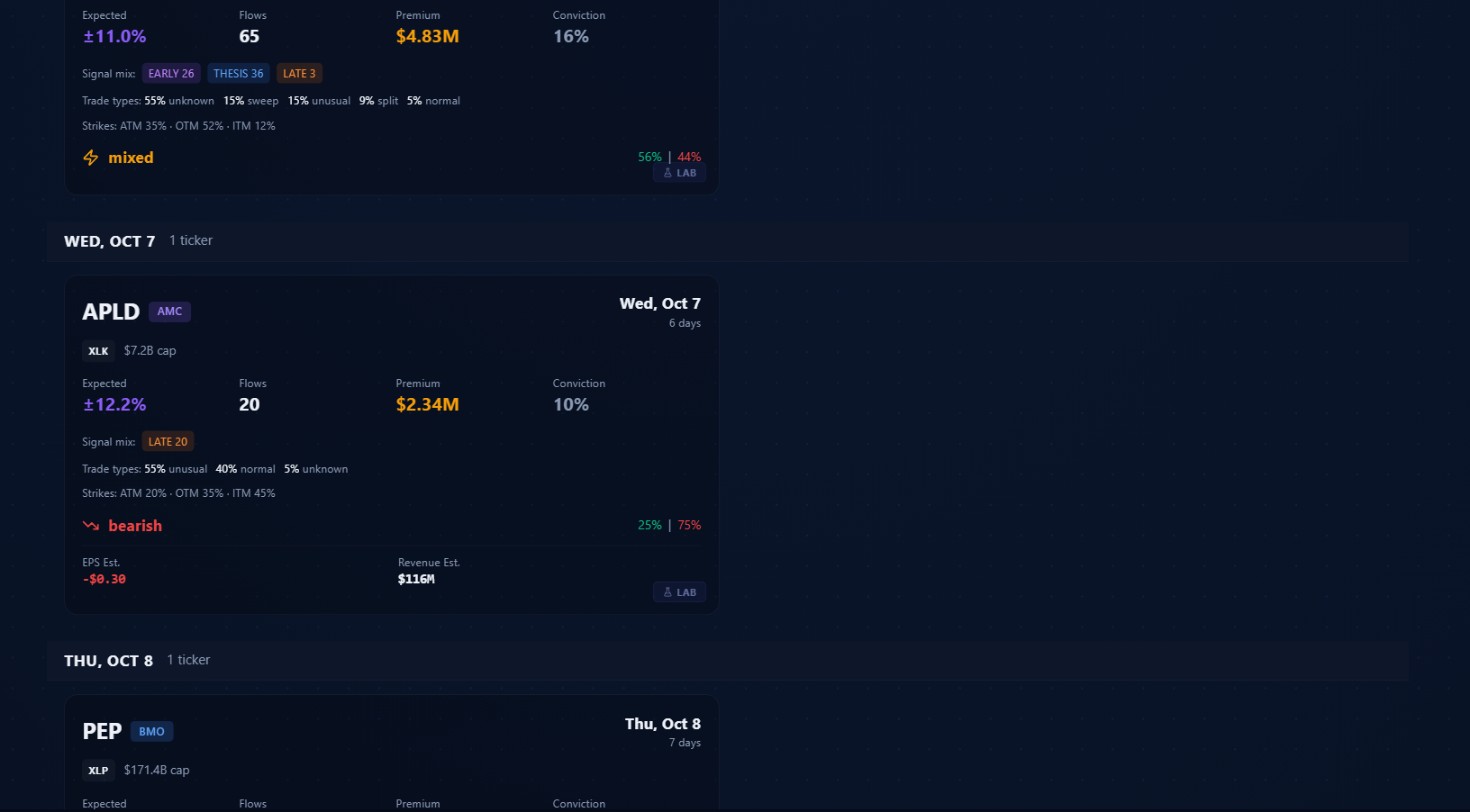 APLD on Oct 7: LATE 20 signal mix, 25%|75% split, 10% Conviction. PEP on Oct 8 shows BMO report timing, XLP sector, $171.4B cap.
APLD reports after the close October 7. XLK, $7.2B cap, expected move +/-12.2%. Twenty flows, $2.34M premium, 10% Conviction. Signal mix: LATE 20. Every print landed in the 3-6 day window. No EARLY, no THESIS. The split shows 25% bullish and 75% bearish, which is why the label prints "bearish."
But the Conviction is 10%. When all prints land in the LATE window (1.0x weight, no amplification) and individual sizes are modest, the weighted consensus doesn't move far from neutral. Small-cap, all late-window flow, low conviction. Someone bought puts in the week before the print; nobody committed size early. That's a different setup than an institutional thesis built over weeks.
PEP is the card to compare against. It reports before the open on October 8, sits in XLP, and carries a $171.4B market cap. The header is all the screenshot shows of it, so here is the pattern to look for on a card like this, not a reading of its numbers: prints landing early in the window, a roughly even bull/bear split, and a low Conviction figure. When premium is meaningful but the split is close to a coin flip, it is either a straddle play (buying both sides into a big move) or two offsetting institutional views running at similar scale. Either way, near-zero Conviction on meaningful early-window premium tells you the professional money has no directional consensus on the name.
Expected move matters on a name like this. A $171B consumer staples company is not priced for a 12% move the way a small-cap software name can be, so the bar to clear for any directional options bet is lower, and so is the potential payout.
The Oct 13-14 bank cluster
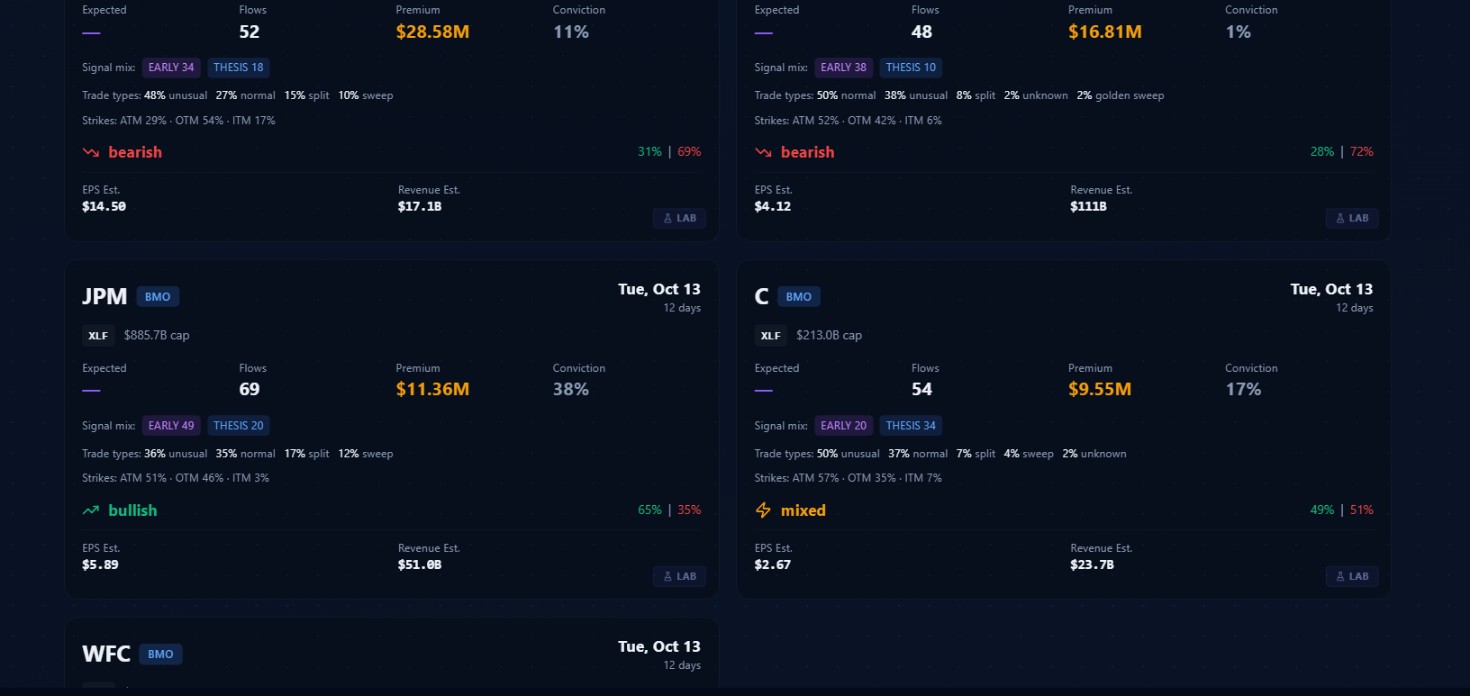 Two XLF names visible: JPM on Oct 13 (bullish 65%|35%, EARLY+THESIS mix, 38% Conviction) and C ($213.0B cap, mixed 49%|51%, EARLY+THESIS flow, 17% Conviction).
Scroll to October 13 and you find several XLF names in a row. The scanner is genuinely useful here because you can compare names with the same sector backdrop side by side.
JPM: $885.7B cap, 69 flows, $11.36M premium, Conviction 38%, an EARLY 49 and THESIS 20 signal mix, and a 65%|35% bullish split. Right at the bullish threshold, above amber Conviction, early-weighted. That's the most directional read in the cluster.
C: $213.0B cap, 54 flows, $9.55M premium, EARLY 20 and THESIS 34, but a 49%|51% split and 17% Conviction. Similar early-weighted positioning to JPM, but the split came out nearly even. Large early-window flow with no directional consensus.
I'll be honest: I'm not sure how much of the bank earnings call buying in any given quarter is directional versus portfolio hedging against held bank positions. The Conviction numbers suggest a lot of it is two-sided, but I haven't tracked it systematically across enough cycles to say with confidence.
Key point: When individual bank cards show early-weighted flow but the XLF sector-level read from Sector Flow is flat or bearish, the bank-specific bets may not be tied to a broader thesis. Always check sector alignment before drawing a sector-wide conclusion from individual card reads.
What I do with a bank cluster: compare it against Sector Flow for XLF. If the sector itself is getting net bullish flow while individual bank cards show early-weighted positioning, that's a converging read. If sector flow is flat while individual names look active, the bank-specific bets may not be tied to a broader thesis.
How this fits with the other tools
Unusual Activity is the scored feed of unusual rows across the full universe, all the time. No earnings filter. The Earnings Flow Scanner is a derived view filtered to the intersection of unusual flow and upcoming reports.
Live Flow shows per-ticker roll-up cards for the $20k+ options tape, with bull/bear splits and the latest notable prints. If a name on the earnings scanner catches your attention, check the live flow on that ticker for the day-by-day directional picture in the run-up to the print.
Heat Map is the urgency board: sector-level premium concentration displayed visually. Good for the big-picture read before drilling into names.
Sector Flow is the sector dashboard, breaking down directional flow by sector ETF. Whether the individual card's directional lean matches or diverges from the sector is one of the first things I check.
Dark Pool captures off-exchange block prints in the stock itself. On earnings week, a large dark-pool print in the same name as strong EARLY bullish options flow is a convergence worth noting.
The Earnings Flow Scanner is the only one in this suite that ties unusual flow to a calendar event and weights the positioning by how early it arrived. That time dimension is what makes it distinct from the other tools.
IV crush (read this if you haven't traded earnings before)
If you've been trading options around earnings for a while, you already know this mechanism. Skip ahead to the next section. If you haven't, this is the most important thing on the page.
In the weeks before a report, implied volatility rises as the market prices in the uncertainty of the binary event. Long options positions benefit from this even when the stock price doesn't move, because the premium they hold is getting more valuable as IV expands. That's why buying a name in the EARLY or THESIS window, even before direction is confirmed, often works: the IV expansion alone can move the option.
Then the report drops. The event resolves. IV collapses, sometimes within seconds, and that compression can overtake the delta gain. Being right about direction and still losing money is the standard result of buying options the day before the print.
Watch out: Buying options the day before a report means paying maximum implied volatility for a binary outcome. Even when direction is right, IV crush on resolution often exceeds the delta gain. The pre-earnings window works when you give yourself runway. Holding through the number is a separate trade with separate math.
This is IV crush, and it's why the pre-earnings trade and the through-earnings trade are not the same bet with the same risk. The Earnings Flow Scanner is built for the pre-earnings period. The ideal structure: identify a name with strong EARLY/THESIS flow and real Conviction, buy the run-up and the IV expansion, close before the print. Holding through the number is a different trade with different math: this page can tell you how other people are positioned, not whether they're right.
The LAB link on every card
Every card has a small LAB icon in the bottom right corner. Click it and Ticker Lab opens pre-loaded to that symbol. Once you're there:
- Pull up the live options chain around the earnings expiration
- See the actual ATM straddle price and calculate the expected move in real time
- Look at the put/call skew (whether downside protection is pricing at a premium relative to upside)
- Model a specific structure against the expected move before sizing
The expected move figure on the card was computed at a specific moment in time. By the time you're reading it the chain has moved. The LAB gives you the live version. If you're going to put on a real position, open it.
Green flags and red flags
Worth looking more closely when:
- EARLY and THESIS counts are high relative to LATE and IMM
- Conviction is 50 or above, especially 75+
- The split reads bullish or bearish rather than mixed
- Expected move is in a range your thesis can argue past
- Sector flow is aligned with the individual card's direction
- You plan to close before the report
Think twice when:
- All signal mix prints are LATE or IMM only
- Conviction is below 20 regardless of the raw split
- Expected move is already very wide. The bar to clear is high.
- The name reports in more than two weeks and you're trying to trade it today
- You're counting on a specific EPS beat rather than a directional move larger than the straddle
Three expensive habits
Treating IMM-only flow as a directional signal. A card with 40 prints all in the 0-2 day window at peak IV is not a thesis. It's last-minute speculation at the most expensive point in the options cycle. The window system exists to separate deliberate early positioning from noise near the event. IMM-only flow deserves a low prior.
Buying the option the day before the report. Maximum implied volatility for a binary outcome. Even when direction is right, IV crush on resolution often exceeds the delta gain. The pre-earnings period works when you give yourself runway: EARLY or THESIS window entry, sell into the expansion before the print. Holding through the number is a separate trade with separate math.
Reading heavy call premium as bullish without checking the split. Institutions buy calls as hedges against short stock positions. A fund short into a print will buy upside calls to cap losses on a bad outcome, and on this page that looks identical to a directional bet. NKE's 48%|52% split on $49M of predominantly call premium from October 1 is the concrete example: a meaningful portion of that call volume was two-sided. The split and Conviction numbers exist to surface this.
Last quarter data
At the bottom of some cards you'll see the previous earnings result: what the straddle priced, and what the stock actually did. "Beat" means the absolute realized move exceeded the priced move by more than 0.5 percentage points, meaning the straddle was too cheap. "Miss" means it fell short by more than 0.5 points. "Inline" is within that half-point range.
One thing worth being precise about: this is one data point per ticker. The system stores the most recent prior earnings result, not a multi-quarter history. If a name beat its straddle last quarter, that's real information. One result is not a pattern.
On rare occasions a card flags that the BMO/AMC session label for the prior quarter couldn't be fully corroborated. When that appears, the direction is shown but marked uncertain: the system is telling you there's ambiguity in which measurement window the realized move was taken from. Treat it as directionally informative rather than definitive.
A working routine for earnings season
At the start of each week during reporting periods, I open the scanner sorted by Earnings date, All days, All bias. Scan through date groups and note which days have three or more names.
For any card with aggregate premium above $5M, I read the signal mix first. EARLY-heavy or IMM-heavy? If the mix is EARLY and THESIS with Conviction above 50, that goes on a shortlist.
For shortlist names, I open the LAB link to price the live straddle. I check Sector Flow to see if the sector-level read aligns. If both point the same direction and the expected move is a number the thesis can argue past, that's a name worth building a position framework around.
For names I'm watching but not trading, I track the outcome anyway: expected move vs. what actually happened. One full earnings season of doing that builds a real sense of how this positioning data calibrates across the names you follow. That's more useful than taking anyone's word for it, including mine.
Tools that pair with this page
- Unusual Activity: the scored feed of unusual flow across the full universe
- Live Flow: per-ticker roll-up cards for the $20k+ options tape
- Heat Map: urgency board for sector-level premium concentration
- Sector Flow: sector dashboard for directional flow by ETF
- Dark Pool: off-exchange block prints for convergence checks
- Ticker Lab: price the straddle and model any structure before sizing
- Earnings Calendar: the full report schedule, whether unusual flow is present or not
Options around earnings carry elevated risk, including complete loss of premium paid. IV crush on report resolution is the normal outcome, and a stock moving in the expected direction does not guarantee an options profit when the premium collapses simultaneously. Nothing here is a trade recommendation or a prediction of any outcome.